So you’ve decided to set out on The Big Adventure. You have your rig, you have a travel circuit in mind, and you’re dreaming of the mountains. If you’re anything like me, though, one step still remains at this point: finding a job.
Lots of nomads have remote jobs. You see them all over social media, posted up in new and unbelievably scenic locations every week. There’s an undeniable allure to this lifestyle.
If you’re still more like me, though, maybe you detest Elon Musk and refuse to purchase a Starlink. Maybe you have a weird degree that doesn’t offer much in the world of online work, or no degree at all. Or maybe the digital nomad life just seems a little too lonely. All of these feelings and experiences are totally valid. In fact, they’ve deeply influenced my own path.
Job applications can be draining, though. If you’re working in person, you’ll have to find new work each season, especially during your first year of travel. Here are my finest tips for streamlining the application process and bettering your odds.
Seasonal work?
The first step in your nomad job search is understanding what sorts of positions are amenable to hiring seasonally, and then adjusting your expectations accordingly.
When I was first setting out on the road, I spent a lot of time searching for editorial and writing positions at local magazines. I soon found that these roles lean more towards full-time employment, unpaid internships, or one-off publication than they do towards seasonal work. Not really ideal for a seasonal nomad, no matter how you shake it. Although this realization bummed me out, it allowed my journey to move and shift in interesting ways, eventually producing the River Gorge Guild as a personal project.

Latte’d up and blogging in Burlington
Either way, you may find that seasonal work demands “harder,” “less comfortable,” or “less glamorous” work than you were expecting. I have friends who toil at onion harvests, gain their summer sea legs on fishing boats, or jump straight from their morning hospitality shifts into evening food service shifts. However, a great deal of the negative concepts clouding these sorts of work are based in stigma and are either exaggerated or not fully accurate. Seasonal jobs can be hard, but it isn’t all bad. Far from it.

My first ever shift at the iconic Miguel’s Pizza
I’ve discovered that I would much rather do this variety of “hard work” than sitting at a desk in silence all day. The freedom of a variable schedule, being able to choose part-time hours, interacting with people all day, and of course, the opportunity to live in magical places, are all invaluable to me.
If this lifestyle sounds like it’s for you, read on!
Find your skillset(s)
Before you set out on the road, select a handful of skills that you either already have or would like to build. Focus on the skills that are applicable in multiple locations, especially the sorts of locations that interest you. If you’re looking to travel to sweeeet, popular spots, food service and hospitality skills are always a solid bet. Generally, other people also want to travel to sweeeeet spots, and those people reliably crave good food and cozy housing. That, dear traveler, creates opportunity for you.
My personal skill array includes barista work, rock climbing coaching and instruction, pursuing a yoga certification, and hospitality. Between these four skills, I’m generally able to find work wherever I want to go.

Light food service skills have helped me tremendously with landing seasonal jobs! Here’s an avocado toast I made for myself at work this summer
It can also be productive to invest in certifications in fields that interest you. I’ve found my AMGA (American Mountain Guides Association) cert invaluable in securing temporary positions at climbing gyms. Other jobs don’t require explicit certifications (although experience is always helpful), like barista work and food service positions. You can always rely on these jobs to support yourself while making progress on certifications in other fields. Certifications can also allow you to freelance, especially in the outdoors world. With enough expertise, you can supplement your work schedule with (or rely fully on) guiding and instructing.
When you’re deciding what skills to build, think about the intersection between what you know how to do, what you want to do, and where you want to live. For example, let’s say you have experience in retail, love to surf, and are looking to travel to oceanfront towns. Consider applying to surf shops and water sport gear shops, as well as looking into an ISA (International Surfing Association) course that would allow you to instruct. With this combination, you could find plenty of work as a surfer without the need to be a pro sponsored athlete.
Use that map
This seems so obvious it’s amost silly, but zooming in on my destination in Google Maps and searching “coffee shops” is exactly how I’ve found many of my recent jobs. This strategy gives you a great spray of every institution in a town, rather than just the five most popular that might pop up in other contexts. Maps searches also allow you to compare walking, biking, or driving commutes from wherever you might be parking your rig.
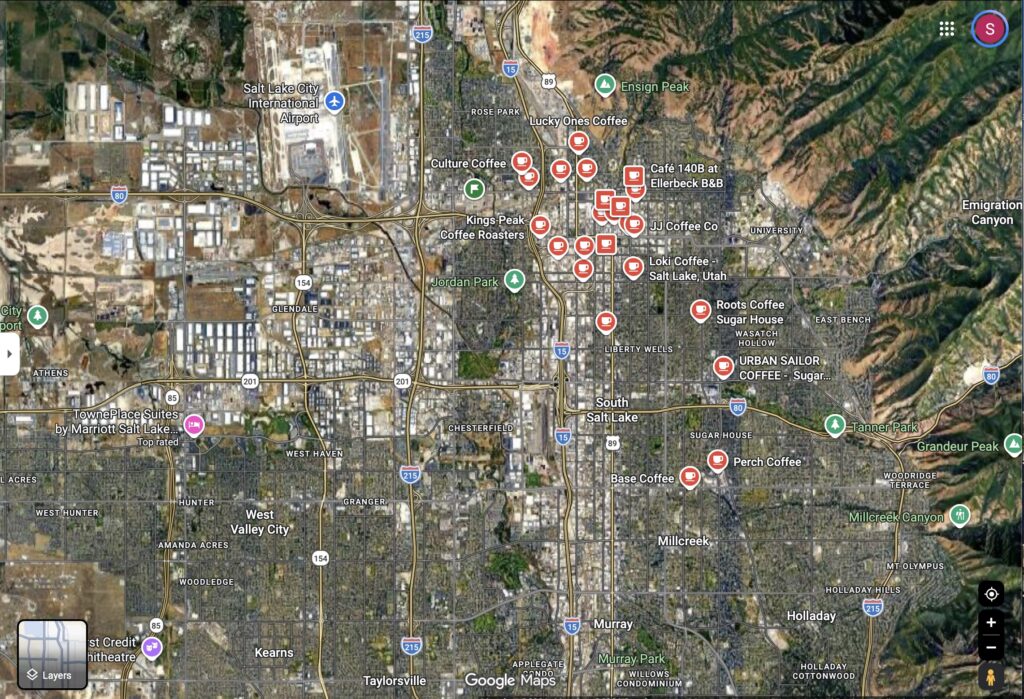
Endless coffee shops in Salt Lake City
Once you type in your search (e.g., “climbing gyms;” “coffee shops;” “marketing firms”), you can adjust the map to encompass exactly the area you’re moving to (e.g., just northwest SLC). Click “search this area” to refine your search for the specific region on the screen.
Volume, volume, volume
This is my least favorite item on this list, and I’m deeply sorry that I must recommend it to you. HOWEVER. I do truly suggest that you apply to as many positions as you can. You never know what won’t work out…or what will.
Casting a wide net does a few wonderful things for you. Firstly, doing so makes it more likely that at least one opportunity will stick. Secondly, it also increases your odds of landing more than one position. That allows you to have your personal pick between several options. And lastly? It’s just great practice. The application process becomes easier every season.
Have a template; adjust it wisely
This goes hand in hand with the previous list item. If you’re sending out lots of applications, it can be exhausting to finely craft each one. Having a general resume and email template speeds things up significantly.
If you are going to take the template route, still be sure to slide in a few specifics with each application. I like to leave a blank spot in my email template to mention what I like about a business’s mission statement, as well as another slot to highlight any experience I have that is especially relevant. It also helps to be willing to move your resume around to highlight those relevant skills.
Persistent and creative contact
Not every business will have an “apply here” button on their website, or even an email. This could mean that they’re not interested in hiring, but it doesn’t always. You might just need to get creative. If you have an Instagram, you can contact businesses via DM. Some businesses are more responsive on social media than they are over email, anyway. You also can always call an establishment, or even show up in person once you arrive in town.
Jobs with housing (or rig parking)
One very special skill that you will develop as a nomad: sniffing out positions that can house you for free (or cheap). Positions with housing are generally a bit rare, but if you can find them, they will save you a TON of cash. Here are some tells that I look for.
- Towns with dense concentrations of young travelers. You might not guess that the Jackson Hole area, which is otherwise quite expensive to live in, offers several work-stay opportunities. On closer inspection, you’ll see that The American Alpine Club Climbers Ranch offers on-site housing, as well as a small cabin resort called Dornan’s. Lots of people like you are interested in this area, and this area is interested in the work you have to offer. That motivates businesses to provide housing.

The Climber’s Ranch on a foggy morning
- Hospitality-adjacent positions. Businesses that lodge visitors anyway often have extra bunks or room to pitch a tent. I’ve found work-stay opportunities at Miguel’s Pizza, which is a campground in addition to its primary status as a pizza shop, and at CoHo, which is a hostel. Work as a campground host is also almost guaranteed to secure you a spot to live on-site (one of my friends does this regularly!), as are several positions at resorts and hotels.
- Highly seasonal areas. In locales like ski towns, summery camping areas, lakes, and beach towns, there are times of year when huge amounts of tourists flood in. Of course, those tourists evaporate when the in-season weather concludes. That means that the workforce necessary to handle all that local work ebbs and flows accordingly. Businesses in seasonal towns understand that ebb and flow, and they sometimes will offer housing to their high-season employees.
Be bold!

Getting blown around in the Rocky Mountain alpine
This goes for any kind of job application, but apply like you’ve already got the job. Request confidently that your parameters be met. If a location you want to work at doesn’t explicitly offer a seasonal position, just inform them frankly that you are looking to work for two months–and really sell why that actually might be a good thing for them. Lean into your skills, expertise, and experience, even if they’re not perfectly relevant. Treat your email like a persuasive essay.
Regardless of whether you know for certain that you’ll be in Salt Lake City this fall, tell all of your potential employers that you will be in Salt Lake City…even if you’re also telling lots of folks that you’ll definitely be in Tahoe, and others that you’ll be in the Red River Gorge.
It’s also totally okay, even ideal, to apply to a few jobs that you’re not fully qualified for if they just really excite you. Weave your safety net thoroughly, then set your sights high.
Conclusions
Working in-person as a nomad certainly requires some grit. That doesn’t mean that you can’t do it. If you’re really just itching to get out there, I urge you to beat your own path. You don’t need a Sprinter van, a remote job, a Starlink, or a successful social media career. Just a sense of adventure and a few sharp skills will do.
The last piece of advice I can give you is to truly believe that you’re doing the right thing, even when you feel alone. Chances are, you won’t meet many other folks who are doing what you’re doing until you arrive at your first seasonal destination. I promise that we’re all out here, waiting for you with open arms.
Leave a Reply