If you’re a short rock climber, you’ll quickly realize that everybody in the world wants to give you advice. Even when these people truly do have your best interests at heart, it can be difficult for taller climbers to provide advice that’s actually helpful. As I mention in an earlier article, it’s really just that difficult to imagine being any size or shape other than you are.
As a 4’11” rock climber and climbing coach, I’m here to provide you with all of the advice I can…from my own deeply personal and seriously relevant experience.
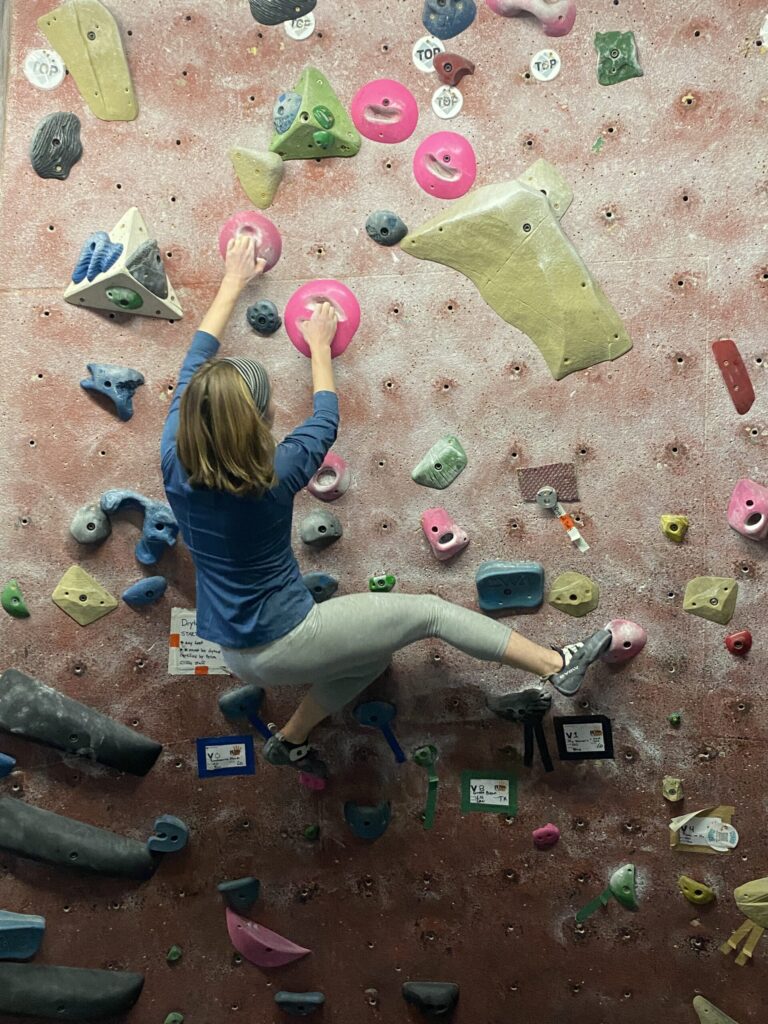
On an awesome, short-friendly boulder in Burlington, VT
I predict that the skills highlighted in this article will be the most helpful for rock climbers under 5’5″ who are still breaking into 5.11 or below outdoors. Of course, though, all are welcome here. I hope that anyone who reads this article can get something worthwhile out of it!
Physical skills
Using underclings to maximize reach
When you’re on a jug, pulling downwards, your wrist will hang below the hold. When you’re using an undercling, pulling upwards, your wrist will be above the hold. If you’re sitting at a table, you can demonstrate this for yourself. Pull down on the edge of the table, then flip your hand and try pulling up on it like an undercling. Notice how your wrist gains a few inches in height?
This is just how finding sneaky underclings, and using those instead of the obvious jugs on a route, can help you break a reach crux. Even a totally crap undercling can give you a boost of several inches. Another pro of using underclings is that it’s much easier to smear. That means you can use this trick even if you can’t reach the good foot chips.
Heelhooks and high feet
Depending on body position, throwing a high heel might become possible before you can notch in a high foot. Further, once you have a high heel hook, you then have the option to rock over onto that foot. I have two main tips for you here.
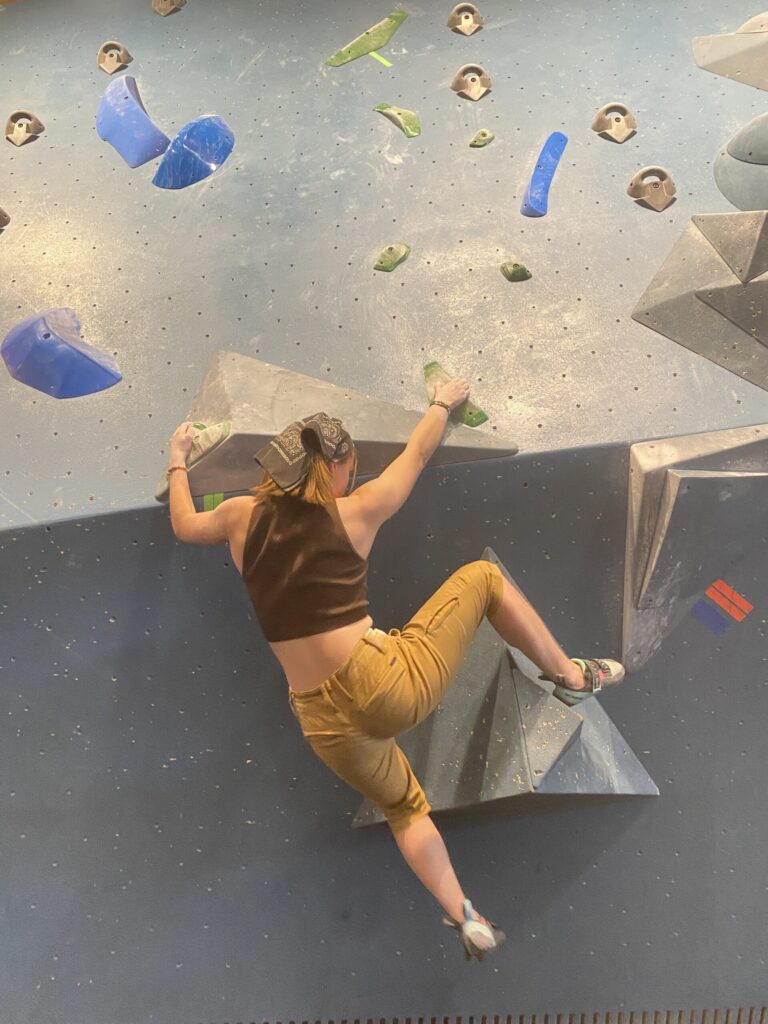
A heel from the author in Salt Lake City
- Learn how to heel all kinds of holds. In the gym, routesetters will often give you a jug or an otherwise obvious, bowl-shaped hold to indicate where they want you to heelhook. The secret, though, is that you can heelhook almost anything if the body positioning is right, especially outside. Practice heelhooking even when it’s unnecessary, and just see what you can stick. It might be more than you think.
- Work on heelhooking correctly. If you want your heel to stick strongly enough to pull into a rockover, it’s paramount to heelhook right. While you can just passively wedge your heel somewhere, heelhooks are most effective when they’re active. Point your toes as hard as you can and engage your hamstrings to activate your heelhook. Think about pulling your heel towards your body, as if the rock is made of fabric or tissue paper and you’re trying to wrinkle it with your heel.
- I have the climber/yogi Ieva Luna to thank for this wrinkling analogy, which she often uses to describe heel traction in half-splits
Using high feet is also an essential skill for any small climber. As I describe in a former article on the differences between big climbers and little climbers, having shorter legs can make it more difficult to use the obvious feet on a route. A foot chip that falls mid-thigh for a 5’10” climber might be above the hips of a 5’2″ climber. The unfortunate solution? Learn how to step above your hips. Stepping high like this requires two abilities:
- Flexibility. Perhaps the more obvious of the two. Some people are naturally flexible, but if you aren’t, you can always improve! I include a short list of my favorite stretches later in this article.
- Lower-body strength. Just getting your foot to the hold isn’t enough–you also have to be able to stand up on it. To work on this skill, you can practice lower-body exercises that require leg extension and balance, such as pistol squats, deadlifts, and good-mornings.
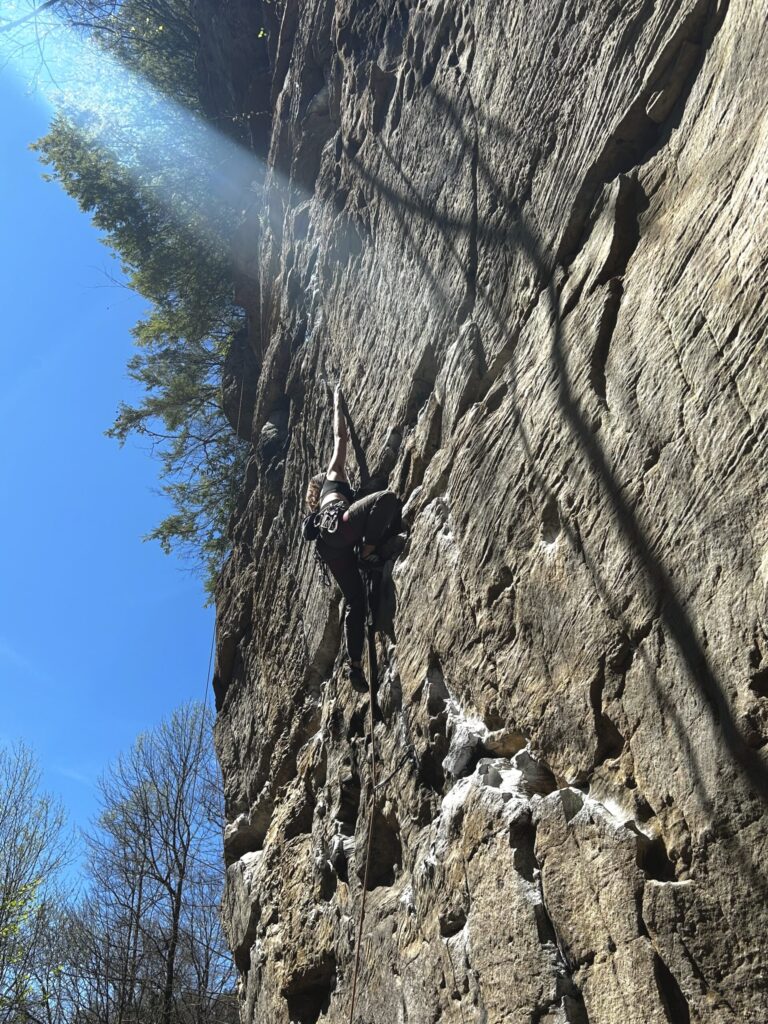
The writer rocking onto a high foot after letting go of the bottom foot. Photo credit to our wonderful friend and fellow rock climber Abby
Hip-to-the-wall and dropknees
This simple positioning tip will help you get a few inches closer to out-of-reach holds. If your hips are square to the wall, they will naturally be a bit further away from the wall as well. Twisting one hip towards the wall and/or turning one knee inward, though, pulls your hips closer and lengthens your reach. Watch an excellent video explaining this phenomenon here.
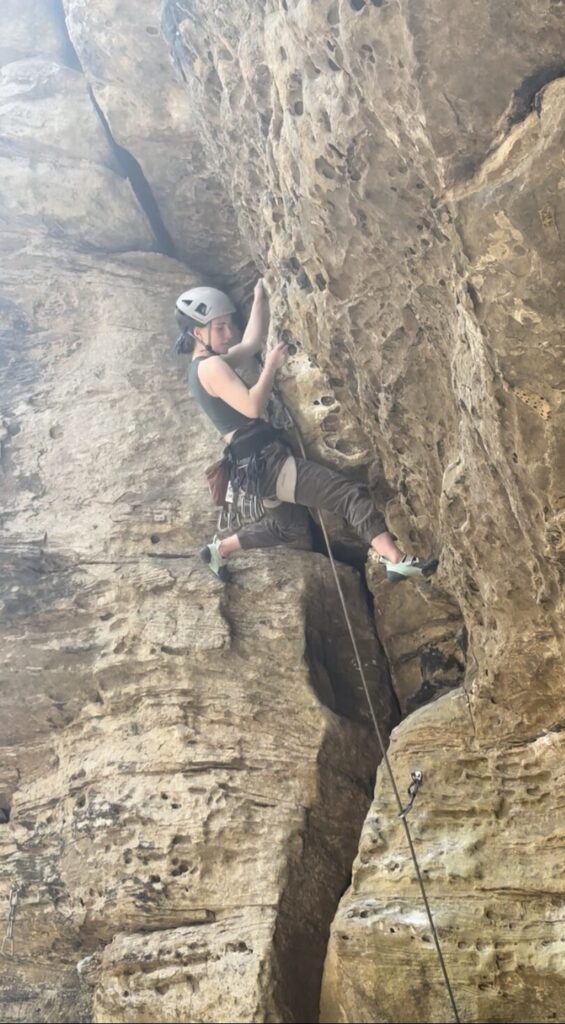
A left dropknee on Holy Grail
Getting that left hip in for a reach on the spray wall
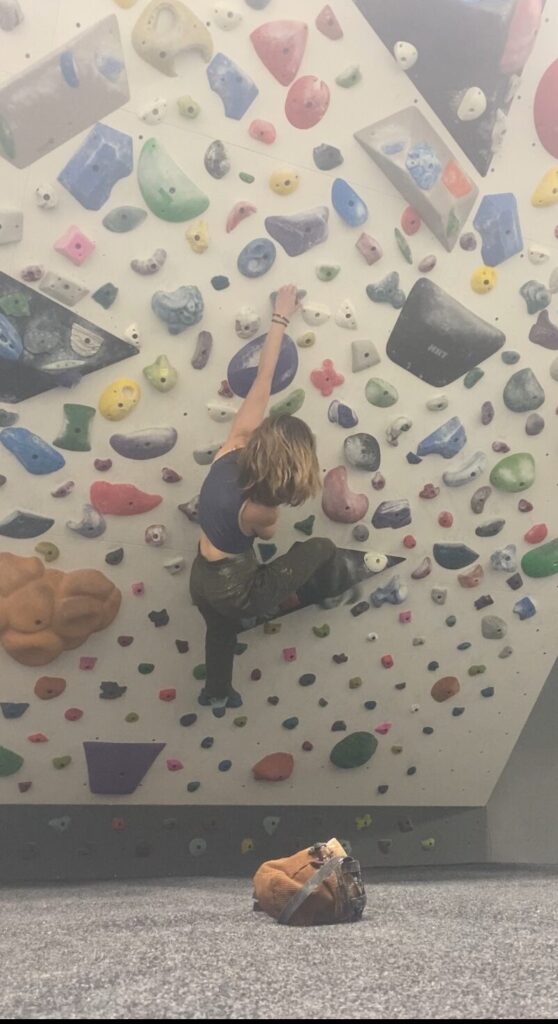
Twisting one hip into the wall also makes it much easier to stand up from a bent leg.
Stretching and Yoga
As a shorter athlete, becoming bendier has afforded me the important ability to use my body in more unique and creative ways on the wall. Some of my favorite stretches for high feet are lizard pose, pigeon pose, and butterfly. Forward-bends and side-bends are also great for lengthening your reach. If you’re unfamiliar with these stretches or are new to yoga, I encourage you to check out two femme yogis that I love very much, Gabby Colletta and Ieva Luna, for references. Ieva Luna is also a rock climber, and she designs her flows with fellow climbers in mind.
Don’t push it too hard in any of these positions. Take deep breaths, and expect progress to occur over several sessions, not in just one. You’re perfect as you are at each moment!
Working the feet up
When you get stuck on the wall, your feet are much more likely to unstick you in a pinch than your hands are. Intermediate footholds are more common than intermediate hands. The next time that you’re at a loss below a big reach, try looking down before you look up. You might just be able to step a bit higher.
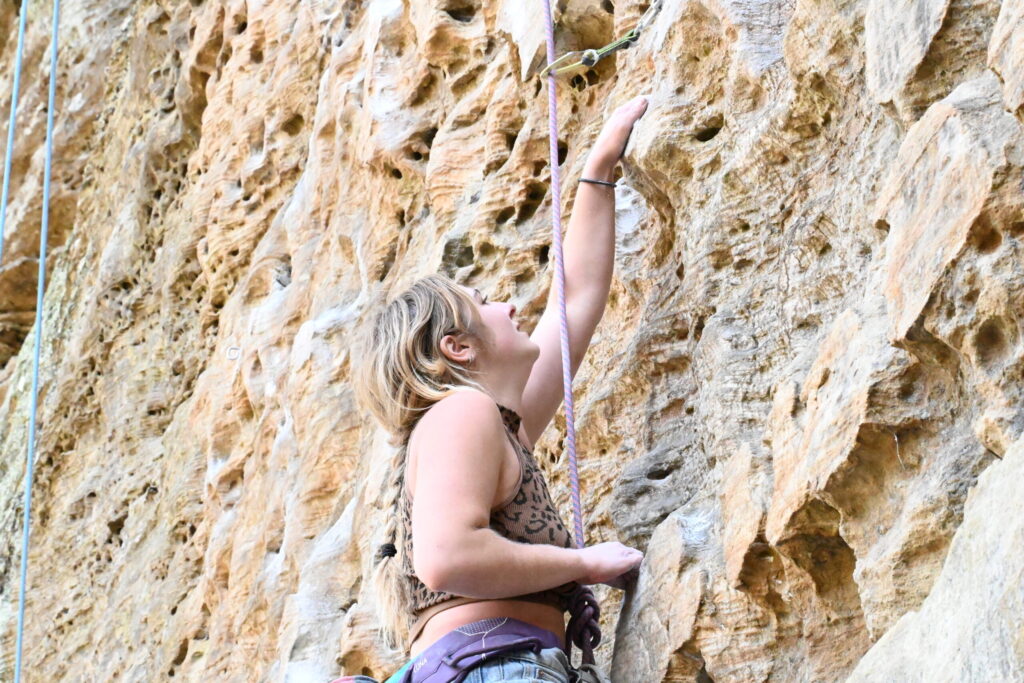
Abby showing us how it’s done on Plate Tectonics
Here are three of my best tips for finding and using intermediate footholds.
- Spot them early. It’s easy for a bangin’ foothold to disappear beneath a roof or bulge right when you need it. Take note of potential intermediate feet as they pass your eye-level and try to remember where they are so you can use them later.
- Be confident. Small footholds can smell fear. The more weight you put into your feet, the more likely they are to stick.
- Be precise. The difference between the best and worst part of a foothold can be less than a centimeter. Make sure you have your big toe exactly where you want it before you look up at your hands again.
Mental skills
Acceptance and trust
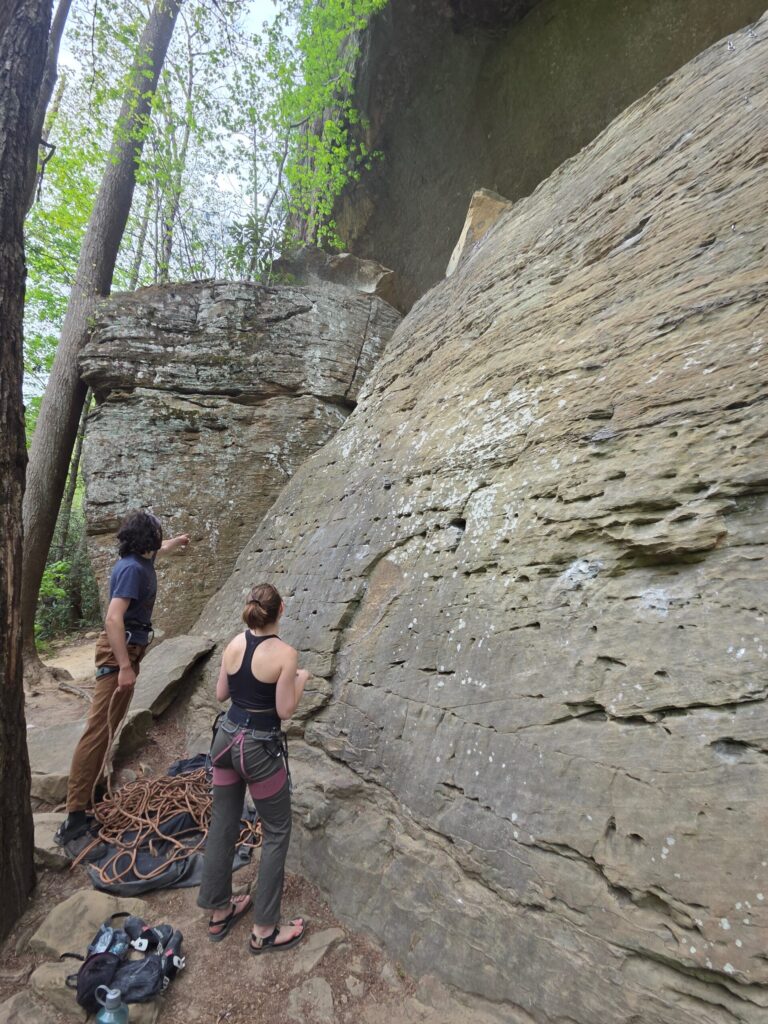
Discussing routes with Tomo. Awesome photo captured by his brother Nick
If you’re a short climber, it’s hard to predict just how difficult a sequence will be, even if you know the grade of a climb as a whole. Grades mean much less if you have an abnormal stature (including if you’re unusually tall!). This means that you might find a stopper crux on a route that’s supposed to be a warmup, or have an exceedingly chill time on a route that’s above your onsight grade.
This can, for obvious reasons, be extremely frustrating. Looking up at a crux can feel daunting if you don’t know whether you’ll be pulling 10d or 11c moves to gain the next clip. When I was newer to outdoor climbing, this frustration was totally overwhelming. It all just felt so unfair!
I’ve discovered that the best way out is through. The first step is a sort of radical acceptance; namely, accepting that written grades will usually not match your climbing. Sure, it’s unfair that you have to pull more difficult moves than everyone else. Confronting route developers on their bolting or creating a local short climbers’ network is a problem for later, though. When you’re on the wall, all you can do is climb, no matter how hard the climbing is. This radical acceptance is easier said than done, of course, and is always an ongoing project.
Trust is the next step. Learn to trust your own strengh, even if you’re executing beta that’s more difficult than the listed grade. Trust that your belayer will catch you if you totally miss one of these hard moves. And trust that, no matter what happens, everything will be okay. You’ll still love rock climbing at the end of the day (or, at least, by the end of the week).
Managing fear
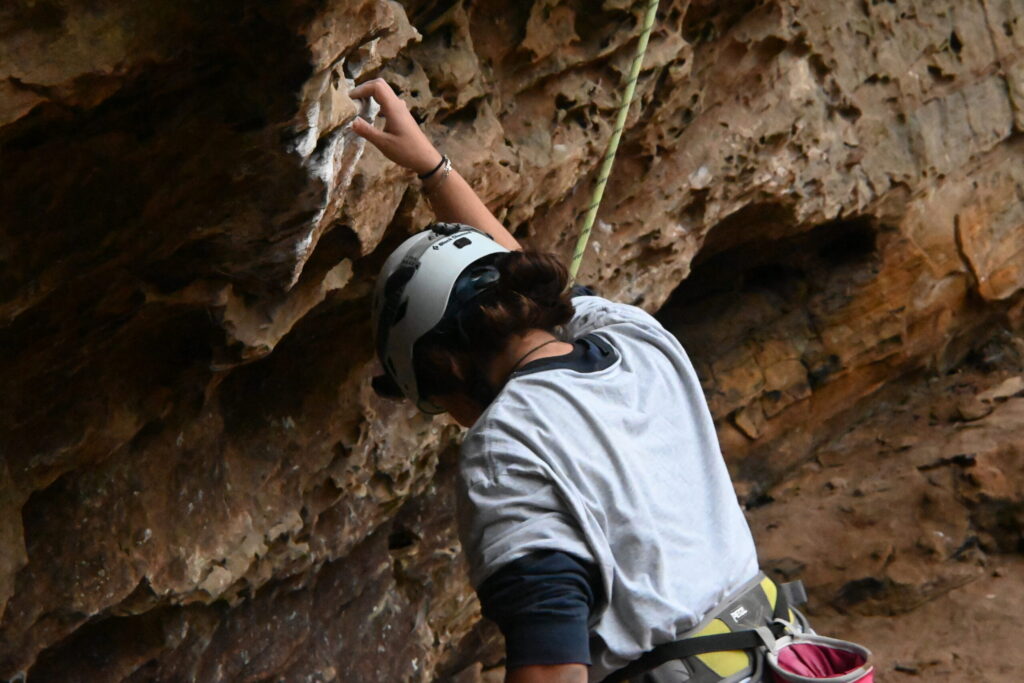
Our dear friend Grace taking a deep breath before starting Starry Night last fall
This unpredictable-difficulty phenomenon can be just as terrifying as it is frustrating. Here are my two best all-encompassing tips for managing the fear of the unknown.
- Practice within the “known.” Most fearful climbers have received the following piece of bad advice at some point: just take a huge practice whip, and then your fear will go away! If you’re already scared, though, taking a massive practice fall to “get the jitters out” can actually fill you with unnecessary adrenaline and overwhelm your nervous system. It also cements an unhelpful mental association between fear and falling, teaching your brain that you will always be scared when you whip. Try taking smaller, announced falls first to build your confidence. I learned this strategy from the general manager at the climbing gym where I used to work, who also taught our lead climbing classes.
- Practice meditation and focus. There are countless kinds of meditation out there, spread among numerous religious and secular traditions. Most types, though, have one quality in common: filtering through your thoughts, tossing aside the thoughts that don’t matter, and focusing on the thoughts that do. Here are some strategies I’ve learned from my own practice as a Buddhist.
- You can practice this meditation on the wall, while sitting at a bolt, or just before climbing. Breathe in and out consciously, counting each exhale. Count only to eight or ten, then return to one. If you catch your thoughts drifting to anything other than your breath, start your count over at one. If you’re feeling extra distracted, don’t just count your breaths; also focus on perceiving the breaths. Notice the temperature of the air and its texture as it enters and exits your nostrils. This strategy can help block out fearful or doubtful thoughts.
- If counting your breaths is too distracting while actively climbing, try a more casual meditation by focusing on the physical sensations of climbing itself. If I’m feeling afraid or overwhelmed, sometimes I turn my attention to the texture of the rock and its friction against my finger pads, trying to notice every little thing. Grounding yourself in your body leaves less room for anxiety to take root.
Advanced route-reading
If you’re under 5’5″, you’ve probably experienced lots of people telling you that you should just use their beta…even when doing so is either impossible or incredibly difficult. Two skills become helpful here.
- Knowing when someone else’s beta isn’t right for you. You know your body better than anyone, regardless of how your belayer might attempt to wheedle you into a folly deadpoint instead of using an intermediate crimp. I’ve collected lots of strategies for this, especially the elbow trick. In general, pay attention to your body when you rock climb, and file away which kinds of moves are possible for you and which are not. The more you practice this skill, the easier it will be to distinguish between helpful beta and beta that should be disregarded.
- Finding alternate beta. One of my favorite strategies here is being bold enough to try out holds that are unchalked. Sometimes, they’re just what you need. Similarly, hidden underclings, tiny intermediate feet, narrow slots, and monos that nobody else would dare use can become your new best friends.
Demonstrating the short-person start hands on Portrait at Bibliothek after putting it up
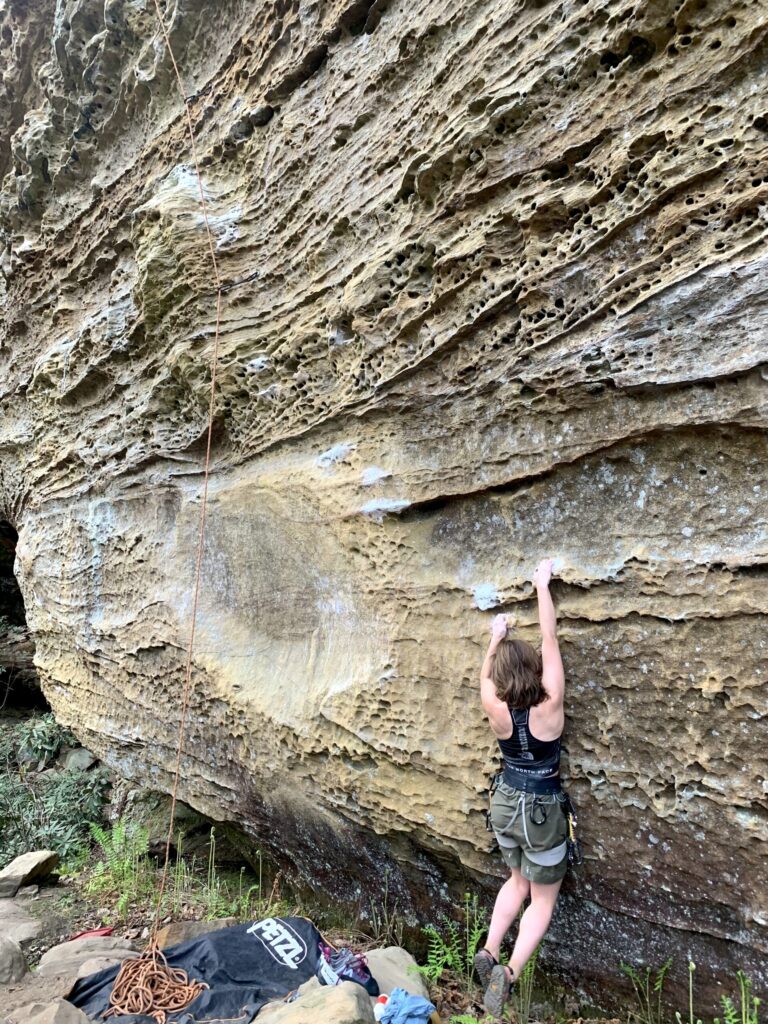
Picking the right route for you
While I like to think that my patience in many areas of life has improved with time, I have also grown much less patient with reachy rock climbs. Here’s a secret I’ve discovered as a result of this impatience: you actually don’t have to climb everything that’s recommended to you. “Classic” status is a consensus quality, and it’s important to remember what crowd that consensus is sourced from.
If you’re a climber with unique dimensions, there are many other important factors to consider than whether the average climber gives a route four stars. A classics list is a good place to start, but don’t forget to look at the style and rock-type of a climb as well. The first thing I personally look for is intermediates. Not just intermediate hands–but also rock types that lend themselves to intermediate feet. A lot of times, this means rippled or pocketed sandstone like the rock at Bibliothek and on Hippie Speed Ball, or pebbled composite like much of Smith Rock.
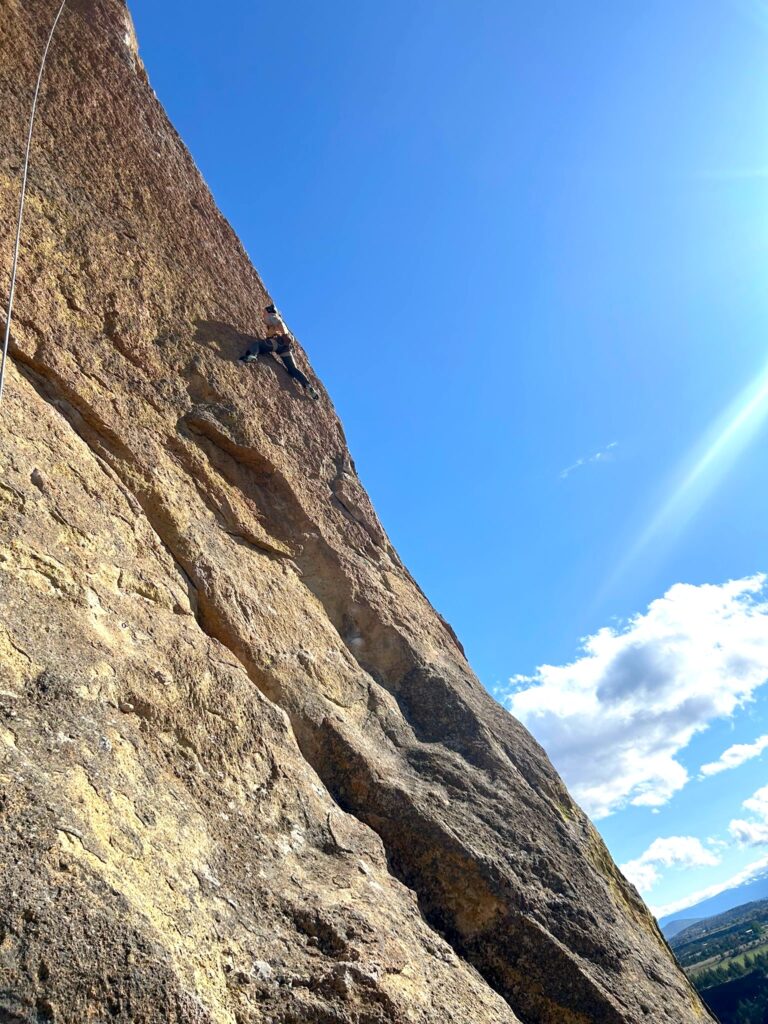
Enjoying a type-1-fun toprope flash of Moons of Pluto last year
I also have become wary of routes with blank faces between spaced-out jugs. Even though this style is very joyful for some people, there are less hold options to choose from, making it more difficult to break the beta. Of course, this doesn’t mean that you should never attempt routes like this if you’re a small climber. It only means to be prepared for a greater discrepancy between the written grade and the difficulty of your own beta.
Conclusions
My dearest short climbers, in many cases it is simply true that you have to have extra skills, strength, or flexibility to climb the same grades as your larger companions. I hope, though, that you can see it as a power that you hold, rather than a weakness. An opportunity for creativity. A source of motivation to perfect your craft. More than anything, I encourage you to judge yourself by your own standards–not the standards of people who don’t look at all like you.
Make your own classics. I dare you.
Leave a Reply