

As rock climbers and outdoorspeople, we need a lot of stuff. Hardware like cams, nuts, and quickdraws, warm base layers and heavy coats, durable shoes, and countless other products are all instrumental to our safety and comfort. As a consumer who cares about nature, you’re in a tough spot. How can you best uphold your personal sustainability goals while still acquiring the gear you need to enjoy the outdoors?
Unfortunately, it’s never been a more confusing time to be a consumer with strong ethics. Greenwashing is everywhere: a tactic in which businesses make their products appear more environmentally friendly than they really are. Compassionate purchasing is becoming increasingly difficult as consumers are faced with vague carbon goals, packaging with doodles of happy animals but no cruelty-free badge, and weak sustainability initiatives.
Here’s a quick guide to what indicators of sustainability and compassionate craft matter, and which ones are marketing BS.
In the conclusions of this article, I also provide some strategies to consume kindly even if there is a financial or situational barrier between you and the sorts of products I’m describing.
Sustainability indicators that matter
bluesign Approved
This certification applies to textiles. If a product is bluesign approved, then it has undergone rigorous assessment at all levels of the supply chain to ensure that it meets high standards of sustainability and safe working conditions for employees. Instead of just “testing finished products” for dangerous chemicals, they conduct site visits to every factory involved in the manufacturing process of a given product and ensure that their standards of non-harm are achieved (“Frequently Asked Questions About bluesign”).
bluesign has a particularly strong focus on energy consumption and water usage. This manifests in their requirement that companies meet specific conservation goals for both resources and that important water sources aren’t contaminated by harmful chemicals.
There are two main ways to tell whether a product is bluesign approved or is made with bluesign approved materials. Approved products might have an extra tag, which will be blue with white text and say either “bluesign approved” or “bluesign product.” If you don’t see this signature tag, you can flip through the other tags on the product to see if bluesign is mentioned in the ingredients.
Certified B Corporation
Similar to bluesign approved materials and products, Certified B Corporations meet holistic ethical standards across multiple social and environmental justice categories. Read about the “B Lab’s” strict standards here. The categories of these standards include Climate Action, Fair Work, Human Rights, Government Affairs and Collective Action, Environmental Stewardship and Circularity, and Justice, Equity, Diversity, and Inclusion, among others.
A product from a Certified B Corporation will have an insignia on the tag that looks something like this
The “B Lab” also responds to formal complaints of misconduct and takes disciplinary action. This means that they keep constant tabs on the organizations they verify and are unafraid to revoke certifications when businesses don’t meet their standards.
Organic Materials
Organic food and materials can be indicated with a variety of different certifications. If you’re based in the United States, look for the USDA Organic Certified label. Products with this certification have met several criteria relevant to the environment’s health and your personal health, including being GMO-free, using only natural fertilizers and “eco-friendly pest control,” and being traced from farm-to-store. The USDA’s experts also perform yearly inspections on the farms they certify, confirming that their expectations are actually met and upheld.
Here’s what to look for, especially on food
GOTS, or the Global Organic Textile Standard, is also a trusted certification. You can look for the GOTS certification when purchasing gear made from natural materials, such as cotton or hemp clothing.
Fair Trade Certified
Fair Trade USA ensures safe working conditions and fair compensation for products and labor, helps build and sustain communities, and urges supply chains towards fuller transparency. This certification has a wide reach, and it can be seen on anything from whole factories to produce from specific brands.

Fair Trade Certified products will display this logo, or something similar
The Fair Trade certification is perhaps best known for certifying coffee and chocolate.
Rainforest Alliance Certified
The Rainforest Alliance has a similar goal to many of the other certifications here, but its focus is narrower. Only products produced in our planet’s precious rainforests are elligible for certification from the Rainforest Alliance. To receive a certification, these products must adhere to a set of regulations that protects both rainforests and the people whose livelihoods are rooted in them.
The Rainforest Alliance has two main certifications: the Sustainable Agriculture Certification and the Regenerative Agriculture Certification. Read about them here. Similarly to the Fair Trade Certification, the Rainforest Alliance certifications are often seen on reputable and ethical coffee.

Buying fair trade or rainforest alliance certified coffee beans and grinding them yourself is often much cheaper (and arguably yummier) than buying a latte
Certified Vegan
This certification guarantees that a product contains no animal-derived ingredients, nor been tested on animals. This label is much more comprehensive than the “cruelty-free” label, as it includes all of the “cruelty-free” standards with a number of additional regulations.
There are a few different organizations that certify vegan food and products, but here is the logo for one of the most common ones
It’s important to note that food is not the only thing that can be vegan. You can also look for vegan clothes, shoes, and climbing gear. Evolv has a lot of really wonderful vegan shoe options, and the vegan Skwamas are probably the best climbing shoe I’ve ever owned.
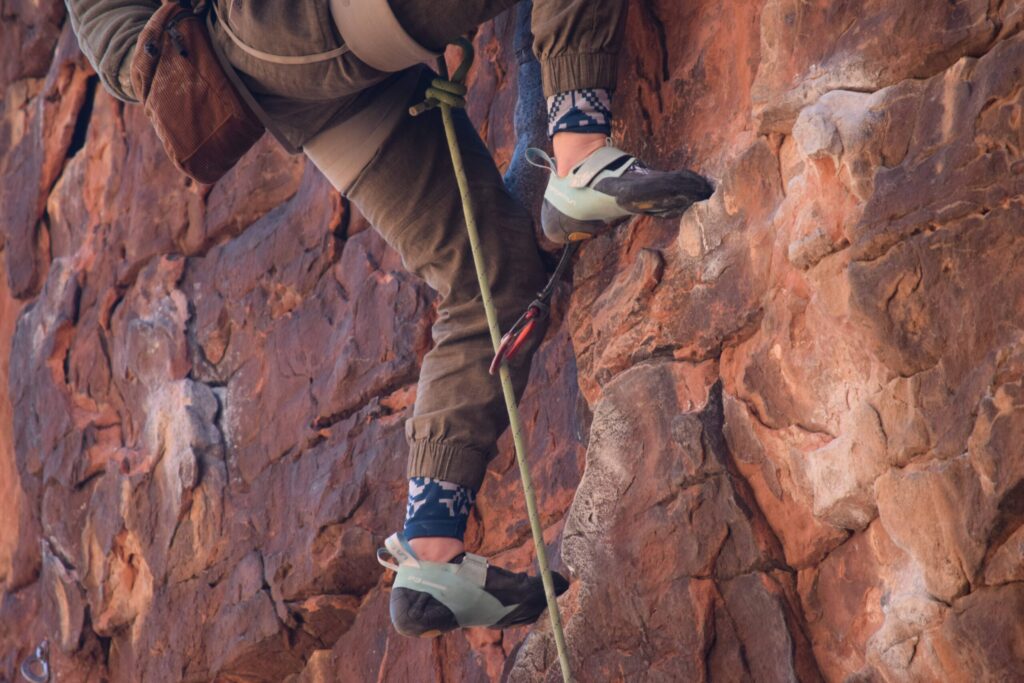
Me rocking my vegan Skwamas on Glitter Gulch in Red Rock Canyon. Photo from Bailey White
Actionable or already achieved carbon goals
One of the main things to be wary of when deciding whether to trust a brand is vague language. All too often, a company will claim that they are seeking to “reduce” their carbon footprint, “minimize” carbon emissions, or “offset” their impact. These claims are not specific enough.
When seeking out truly carbon-conscious companies to buy from, look for specific and actionable claims. We’re talking fully transparent numbers and data, evidence of past successful action, and straightforward, clear, and measurable plans. Patagonia does a particularly good job at this.
You also want to keep an eye out for strong numbers from the past, too. Companies that have already taken big steps for sustainability initiatives can be more trusted to uphold their promises in the future, too.

Me wearing a thrifted Patagonia fleece while hanging out in my trailer. Purchasing or acquiring clothes secondhand is another great way to additionally reduce your impact
Sustainability indicators that are BS
In general, be wary of unsupported and vague claims. This is why it’s so important to recognize the emblems that go along with reputable certifications. Some certifications, like the ones listed above, don’t need much further explanation; all of the factual support and research is wrapped up in the certification itself.
Impactful but unsubstantiated words, though, like “sustainable” or “green,” are not official certifications. Any product that claims to be “sustainable” should provide additional evidence or a certification. Here are some terms that don’t mean very much unless they’re supported by transparent data.
“Sustainable” or “Sustainability”
Any product that claims to be “sustainable” must tell you two additional things: what exactly it’s sustaining and how it’s doing so.
There’s a lot of different things that a “sustainable” product can conserve. Does the company that makes your product have emissions reduction goals? Is the product an appliance that’s energy-efficient when you run it? Does the product use less water over the course of its production than other similar products? If the “sustainable” product you’re purchasing doesn’t mention at least one of these conservation goals (or something similar), it might not be sustainable in any genuine or meaningful way.
A truly “sustainable” product will also be able to report numbers or certifications that elucidate how well they’re actually doing at conserving what they say they are. This can mean percent reductions in carbon emissions over the years, clean water standards that are actually met, certifications that the product contains no detectable amount of harmful materials or ingredients, and so on.
“Environmental” or “Environmentally Friendly”
Similarly to “sustainable” products, if a product is genuinely “environmentally friendly,” the company must be able to tell you what they are doing for the environment. Crop rotation and soil health, wildlife protection initiatives, organic farming, vegan certifications, water contamination parameters, and more are actually good for the environment. Sponsoring an outdoor sport athlete or just being an “outdoorsy” brand is not, necessarily, good for the environment without additional ethical commitments.
“Eco-friendly” or “Eco”
“Eco-friendly” is one of the biggest buzzwords in the world of greenwashing. You’ve probably seen it before, and you may have also already realized that it means almost nothing without data or the backing of a third-party certification. I highly recommend looking for the specific certifications that I mention in this article.
If a given “eco” product doesn’t have any further certifications but you still would like to purchase it, the first step is to see what exactly is “eco-friendly” about the product. If there is no further information on what makes the product “eco,” the product is probably not that “eco-friendly.” If there is further information, decide if that information seems meaningful.
In cases like this, the ingredient list is your best friend. A product that’s 5% recycled materials? Not particularly “eco.” A product that’s more than 50% recycled or made of organic cotton? Now we’re getting somewhere.

Me in a cozy recycled base layer from REI. Photo from Bailey White
“Green”
The ingredients on a “green” product may serve as acceptable defense if they’re convincing, but I generally avoid “green” products altogether. Truly environmentally-focused brands often won’t have to claim that their products are “green” to get the point across. They have both data and much stronger words at their disposal.
Clothes with nature logos
This one’s a bit silly, but still worth mentioning. Just because a shirt is from a naturey brand does not mean that it’s made with the environment in mind. Your local birdwatching group is not obligated to print their member t-shirts on sustainable fabrics, and neither is National Geographic.
All of the rules listed above still apply when you are buying from a brand that “should” care about the environment. Read the ingredients and look for reputable certifications.
Vague claims and non-actionable goals
It’s easy enough for a company to say they’re “working on reducing their carbon footprint” or “planning to use less water in production by 2030.” It’s harder to provide clear, data-backed goals. You as a consumer should be looking for numbers (“reduce emissions by 40% by 2030”) and concrete, actionable plans (“treating wastewater to be reused and recycled, thus more than halving our water usage by 2050”).
Lack of transparency
If a company keeps quiet about their ethics, their ethics might be questionable. Look for products with full reports on where they came from and how they were made, and companies who are unafraid to lay out their production process for all to scrutinize.
One of the only exceptions is businesses on the smaller side that might not be able to afford a third-party certification. It still, though, costs nothing (but time) to self-report.
Conclusions and affordability tips
In a capitalist world, there’s only so much you have control over if you’re an individual instead of a large business. You do, however, have some control over what you choose to consume, how often you choose to consume, and how informed you choose to be. I hope that this article can help you, at least, dodge marketing manipulation. At most, I hope it lights a path to responsible consumption that feels meaningful to you.
It also is important to address that there’s plenty of elitist and classist ideology out there that can make responsible consumption feel inaccessible. I’d like to push back on these ideologies. While wealth can sometimes make it easier to access ethical choices sometimes, there are plenty of affordable ways to chase an ethical lifestyle, even if they are less-often discussed.
Where and how you buy things is often more financially relevant than what you buy. Thrifting is an excellent strategy for accessing sustainable brands without paying full-price, and giving a second life to a product is better for the environment than buying new, anyway. There also is no need to find an upscale organic café to consume ethical coffee. If you buy your coffee as whole beans, even fair trade or rainforest alliance certified beans will be much less expensive than buying a latte every day. French presses can be cheap if you find the right one, and plenty of health food stores have free and public coffee bean grinders.
The following strategy might be more difficult to achieve, but I’ll mention it anyway: you can also focus on setting savings aside to buy just a few high-quality items rather than shopping more often and for lower-quality items. High-quality clothing will last longer and usually doesn’t need to be washed as often. This makes it more affordable in the long run if you can manage the up-front cost. Even better: you can often find these “higher-quality” items at the thrift. My favorite Patagonia fleece only cost me thirty-five dollars. Compare that to a brand-new fleece from H&M (a well-known fast fashion brand), which costs $49.99.
In a similar vein, regardless of what stuff you have, strive to keep your stuff until it absolutely needs to be replaced. Learning how to mend can be super helpful for this strategy. I had a good friend at Miguel’s Pizza who was very proud of the booty patch he stitched onto his favorite pair of pants after they tore.

Me climbing in a beloved flannel that I’ve had for more than seven years. Photo snapped by the incredible Bailey White
All that to say, anyone has the chance to strive for a more ethical consumer life if they choose to, and there’s no such thing as living an ethical consumer life perfectly. Every step matters and is something to be proud of, even if they’re small steps. There are plenty of factors that influence how easy or difficult it is to live sustainably, ranging from economic status to something as simple as whether you live near a good thrift store. I hope that the tools provided in this article can help you live more in line with your personal ethics, whatever your circumstances.



Leave a Reply