We aren’t just climbers and outdoorspeople. We’re also neighbors, artists, and humans. Often, we’re counter-cultural, sensitive, and socially aware, too. Either way, we’re all currently living through violent times in which we and our friends are in danger. Here are some songs in the indie genres we all love that capture how we’re feeling about the state of the world.
These tunes cover a variety of social justice issues, from moments so small as one oppossum becoming roadkill to machines as big and gruesome as war. Some of the songs are more on the nose, some of them less, but all of them have something to say. Play them when you need to be reminded that people do care.
There’s no need to listen to these songs in order; nor do they even make a particularly nice playlist to shuffle. That would be pretty intense. Rather, I encourage you to read about each song and pick and choose which one(s) might make you feel supported and seen in a given moment.
Didn’t Know What I Was In For
Better Oblivion Community Center
“Didn’t Know What I Was In For” is one of those songs I will listen to back-to-front, over and over. I did just that when I first discovered it and was trying to uncover every bit of poetry between the lines. By my fourth listen or so, I had settled on an interpretation. “Didn’t Know What I Was In For” is about two things: people being unduly proud of ineffective activism, and feeling small and helpless in the face of humanity’s vast troubles.
Phoebe Bridgers, one of the two powerful songwriters who makes up this incredible duo, told the Rolling Stone that “Didn’t Know What I Was In For” is about “slacktivism”–a little word that neatly sums up all the thoughts I had about this song.
We’re all vulnerable to engaging in “slactivism”, which I think is why BOCC weaves so many narratives into this little song. The speaker alone lives so many lives from verse to verse and is surrounded by countless other characters living their own lives, too. The other characters in this story range from a friend with a boutique in the city who “says she cries at the news but doesn’t really,” to people at the pool saying cruel things to each other in private, to “the man on the off-ramp holding up a sign that’s asking me for help.”
Everyone in this story is either in dire need of help, thinks they’re helping but aren’t actually doing much, or is prevented from helping by factors beyond their control. If you ever feel like any of these three archetypes, give this song a listen.
fuck these foolz that are making valencia street unchill
Field Medic
If you’re angry about gentrification in a town you love, then this song is for you. Although this Bob Dylan-esque tune was originally written about San Francisco, echoes of other cities that have met the same fate can be seen in every line. I personally always think about Asbury Park in New Jersey when this song comes on. New luxury apartments spawn relentlessly by the beach while people struggle to populate their fridges with groceries. The list of other cities and towns undergoing this process is endless.
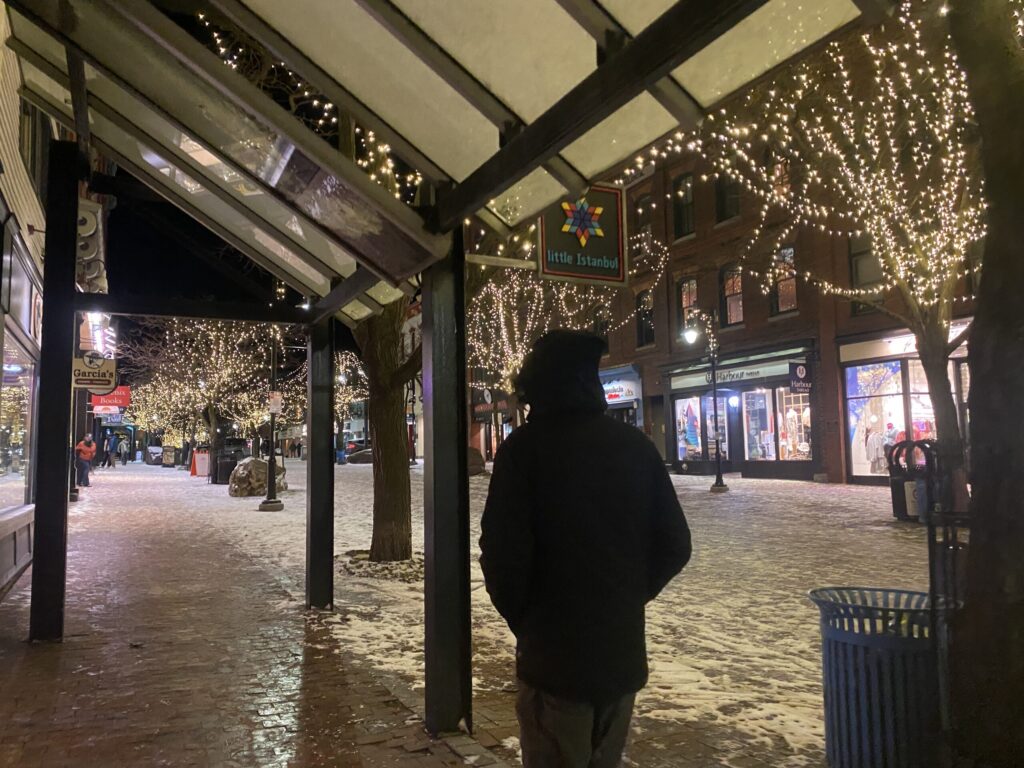
Downtown Burlington, VT, an arts and outdoors haven–parts of which have been the subject of gentrification concerns within the past 10 years
Kevin Patrick Sullivan of Field Medic sings to us about how the poets and artists of society are forced to the fringes while the wealthy flourish without contributing (or, as he criticizes, even voting). As Kevin tells us, gentrification doesn’t just change a city. It can claim a city’s soul, stamping out the qualities that give it its character.
No Kings
Jesse Welles
It’s hard to pick just a few songs from Welles to highlight. His smart, candid, and often very funny lyricism makes him one of the most effective protest song writers of our generation, and I highly recommend you go check out his whole discography.
Anyway–No Kings arose from an anti-Trump protest movement of the same name that manifested in 2025. Welles lifted his own voice up in a timely contribution with the release of this anti-fascism and anti-war tune. Like many of his works, No Kings is the perfect protest song: straightforward, powerful, and sing-along-able.
War Isn’t Murder
Jesse Welles
“War Isn’t Murder,” a reaction to the violence in Gaza, uses another classic Welles songwriting strategy: irony. He piles on line after gruesome line until we can’t help but disagree with the title of the track.
Welles calls out more than just obvious violence, though, using his social and political awareness to cut through the muddy waters. He references Trump’s casual mention of highly contetious real estate plans for the Gaza Strip, which is more relevant now than ever. Welles also criticizes war propaganda that flaunts benefits that normal people will never see, emphasizes that even though “land is a right” it only really belongs to the wealthy, and more. There’s endless context to unpack here. “War Isn’t Murder” is less straightforward than “No Kings,” so I encourage you to listen carefully.
Cigarette Trees
The Local Honeys
Linda Jean Stokley and Montana Hobbs, who together form The Local Honeys, deeply value the art and culture of their home state Kentucky. As Stokley writes in a description of “Cigarette Trees,” The Local Honeys “became intrigued in our last year of college with protest music,” and they began to create songs “reflecting our present-day lives and the issues facing our world.” “Cigarette Trees” is one of those songs. The Local Honeys write what they know in this one, featuring an issue that is close to their hearts: strip mining and its consequences.
Even though The Local Honeys are singing about their own home in “Cigarette Trees,” we all feel the effects of the larger-scale institutions they’re attacking: corporate greed, a lack of empathy for the land, low regard for the well-being of laborers, and many others.
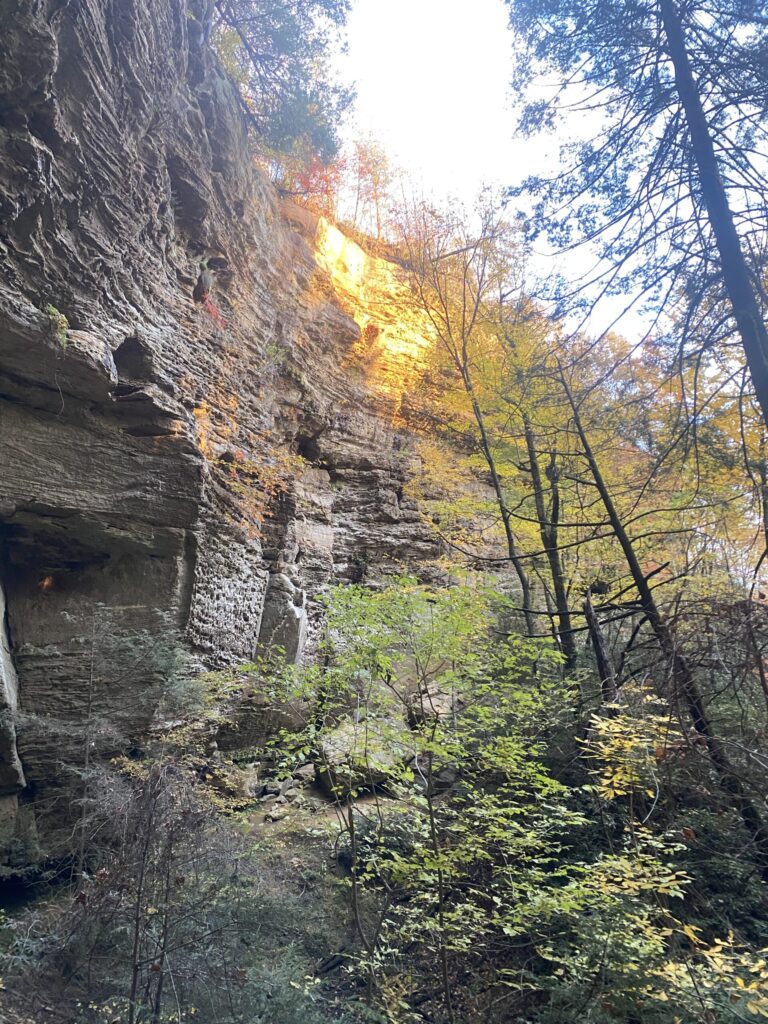
This crag in the Red River Gorge is less than seven miles from the town The Local Honeys reference in their song “The Beattyville Bomber.” If you care about the Red, you should care about what this band has to say!
Sheep
Mt. Joy
“Sheep” began as a response to the murder of Freddie Gray by police in Baltimore, but became more broad as it evolved during the writing process. Eventually, “Sheep” morphed into a general criticism of blindly following hateful ideologies. As quoted in an interview with birp.fm, vocalist and guitarist Matt Quinn explains that “The song itself is really just about people in the majority having a responsibility to do everything in their power to support people who are being oppressed.”
The wide scope of “Sheep” means that its power hasn’t been diminished with time. As the strife of the oppressed only grows, one could even argue that “Sheep” becomes even more powerful every day.
New President
Mt. Joy
Mt. Joy released this one just days before the 2020 election, hoping to encourage the masses to get out to the polls. This song isn’t just about voting, though. Mt. Joy also sings that “we’re gonna march down this boulevard,” a clear reference to peaceful protest, adding that “we’re gonna tear down these fascist clowns.” Mt. Joy makes it clear just how important patience, persistence, and passion are in making a better world. “New President” is a plea for the people to be politically engaged every day, not just on election day, and to understand that you “better give it all your energy,” even when things feel hopeless.
And, as frontman Matt Quinn is quoted in both Under The Radar and Atwood Magazine, “Fuck Donald Trump.”
Buttercup
Hippo Campus
Regardless of what the band’s original intentions for this song were, Buttercup quickly got picked up by women’s rights movements as an anthem of autonomy. It was played to a staggeringly large crowd at a women’s march in DC in 2018, with marchers singing along to lyrics like “I’ll be fine, I’m alright, it’s my body / Gonna stick to my guns like you taught me.” Hippo Campus was delighted to be a part of the movement. They’ve become active members of the sociopolitical scene since then, partnering with the Women’s Foundation of Minnesota, Planned Parenthood, and Everytown for Gun Safety for various ticket and merch sales. You can read about all of this community involvement here in a great Atwood Magazine article about Hippo Campus’s creative journey with their second album.
Respirate
Pinegrove
“Respirate” emerged from the suffering, isolation, and frustration of the Covid era. As frontman Evan Stephens Hall is quoted saying in Americana UK, he had hoped that Covid would be an opportunity to “redesign society so that it works well for more people,” but that instead, the pre-existing systems of oppression were intensified. “Respirate” is “a reminder that we’re in this together,” he explained. This song emphasizes how, if we want to thrive, we have to be comfortable both with relying on others and encouraging others to rely on us. Especially during Covid, but now as well, our default is division. “Respirate” urges us to be better friends and neighbors.
Orange
Pinegrove
“Orange” sprung from a specific moment, just like “Respirate” did: the wildfires in 2020 that dyed the sky blood-orange in the Northwest. “Respirate” is a climate crisis song, but it isn’t only that. The outrage in the song is not directed at the crisis itself, but at the government officials that have allowed it to happen. Pinegrove points their astute fingers at people in power rather than at you and me, unifying us against a common enemy rather than blaming individuals for the damage that only huge corporations could cause. “Orange” is a harsh criticism of government inaction, as well as a rallying cry for us concerned normies to start calling our local politicians when we’re angry.
Neighbor
Pinegrove
This song makes me emotional almost every time I hear it. Like “Didn’t Know What I Was In For,” “Neighbor” balances horror at grave injustice with horror at one’s own inaction. “Neighbor,” though, takes on a whole population that Phoebe and Conor didn’t quite get around to: the natural world and its creatures.
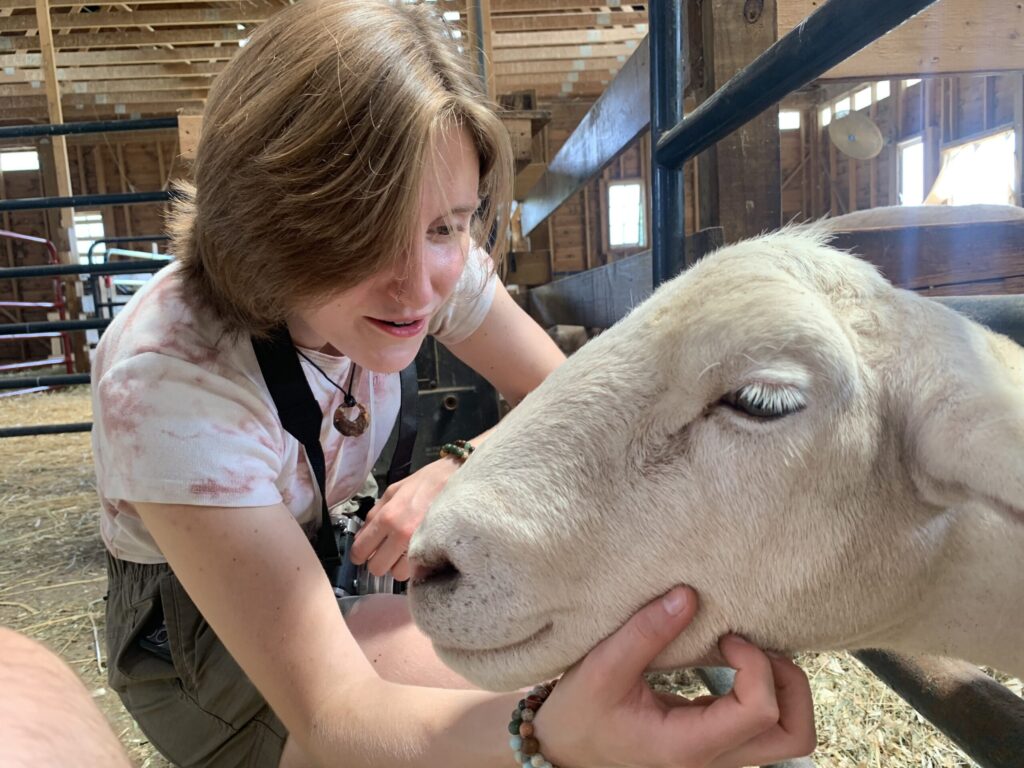
Me with a rescued sheep at Woodstock Sanctuary in New York
Each verse of “Neighbor” focuses on a different creature. It opens on a “little insect,” who the speaker admires for its tenacious struggle to right itself while stuck upside-down. The main character of the second verse is an oppossum that gets struck by a car in a lightning storm. The speaker runs out to help her, but finds themselves paralyzed by fear and disgust. A flock of geese “migrating down easy to a warmer climate” is the protagonist of the third verse, but is quickly met by a villain: a marksman that fires at the geese and “stands up smiling.”
The final chorus of “Neighbor” leaves us wondering who the title is really referencing. All throughout, the animals that our speaker regards with such wonder are referred to as “neighbors,” but the final chorus calls out the marksman as a neighbor, too (albeit one that the speaker loves but doesn’t understand). This tension highlights the true spirit of the song: we are all neighbors, whether we like it or not, and we have some work to do if we really want to look out for each other.
the journey to the center of nothing
Field Medic
Although this song centers the experience of the “starving artist,” so to speak, most young people entering the world these days can probably recognize themselves somewhere in these lines. The cyclic and breathless rhythm of “the journey to the center of nothing” reflects the daily anxiety of survival in our century. It also, at first, distracted me from what Kevin is actually saying to us. “the journey to the center of nothing” isn’t just a list of complaints. It’s sharp, cutting criticism.
Kevin comes for everybody in this song. He attacks our highly polarized politics, the multi-billion-dollar social media corporations that drain our attention spans, perpetuators of war, and the economic systems that keep us all impoverished. It took me a couple listens to catch it all, but it’s worth it. This song speaks loudly to those who are paying attention.
songs r worthless now
Field Medic
Ironic as ever, Kevin uses a song to explain how art is incapable of expressing the true horrors of our times. And, honestly, this two-minute piece is so devastating that it ruined my day the first time I heard it.
It’s unclear whether “songs r worthless now” is about a real or imagined war and natural disaster, but it grows more relevant every day. Kevin sings about how even some of humanity’s most powerful gifts, like words and love, can do nothing to save us in the face of our own self-destruction. Simple and grief-stricken, “songs r worthless now” serves less as a motivator than some of the other songs on this playlist. It’s more like a quiet and empathetic companion.
Bugs
Jesse Welles
I leave you with a somewhat silly song to dissipate some of the gloom we’ve accumulated in this article.
Despite its undeniable goofiness, “Bugs” above all else is a song about radical compassion. Welles gives us so many reasons to love bugs, ranging from the simple logic of “they’re alive / so am I” to emphasizing their essential ecological roles. He urges us to avoid killing them for no reason. That the slight itchiness bugs might afflict us with shouldn’t be punishable by death.
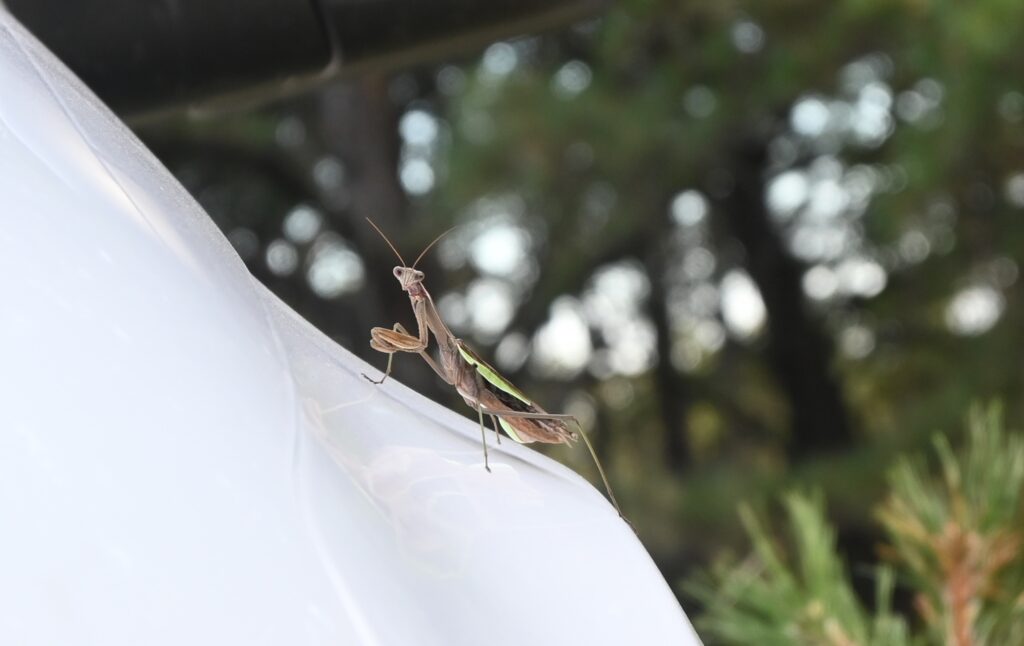
A lovely mantis I saw sitting on a park ranger truck at Peterskill
Welles doesn’t say this outright (at least not in “Bugs”), but we can and should feel this same compassion for each other. If bugs are as easy to love as Welles says they are, why can’t we be just as forgiving of everyone else?
Conclusions
There’s a lot going on in the world right now, and we have much to be angry about. I hope that, above all else, these tunes can help you feel less alone. Whatever might be upsetting you, somebody somewhere is singing about it.
Leave a Reply