

As a life-long classically trained musician, I’ve encountered and dealt with plenty of adversity in the music industry. High-pressure auditions, long and grueling rehearsals, fiercely competitive peers–the works. Perhaps one of the most unfamiliar and daunting challenges, though, was quitting my orchestral career altogether, leaving everything behind, and picking up songwriting instead.
Being a beginner is a rare and beautiful opportunity. In Zen Buddhism (and especially in the works of Suzuki Roshi), perceiving the world with a “beginner’s mind” is a chance to experience incomparable creativity and openness. Wherever you are in your musical journey, I urge you to view the process of learning an instrument with a similar open mind and an eagerness to surprise yourself, rather than as a chore, a contest, or something embarassing.
As a Buddhist, a musician of over a dozen years and, much more recently, a total newbie to the guitar and the ukulele, here’s what I have to say about being a beginner.
**Cover photo taken of me by a friend at Bar Divergente in Toledo, Spain
The best way to learn is just to play.
Especially when you’re just starting out. When I was a brand-new orchestral musician in elementary school, this looked like setting a timer every day and sitting down for a formal practice session. As a music student, I had lots of external motivators to encourage me to practice: benchmark exams, strict teachers, auditions, and more. If you’re learning an instrument just for yourself, though, it’s crucial to give yourself good reasons to play. I’ve found that those reasons are much more effective if they’re rooted in joy.
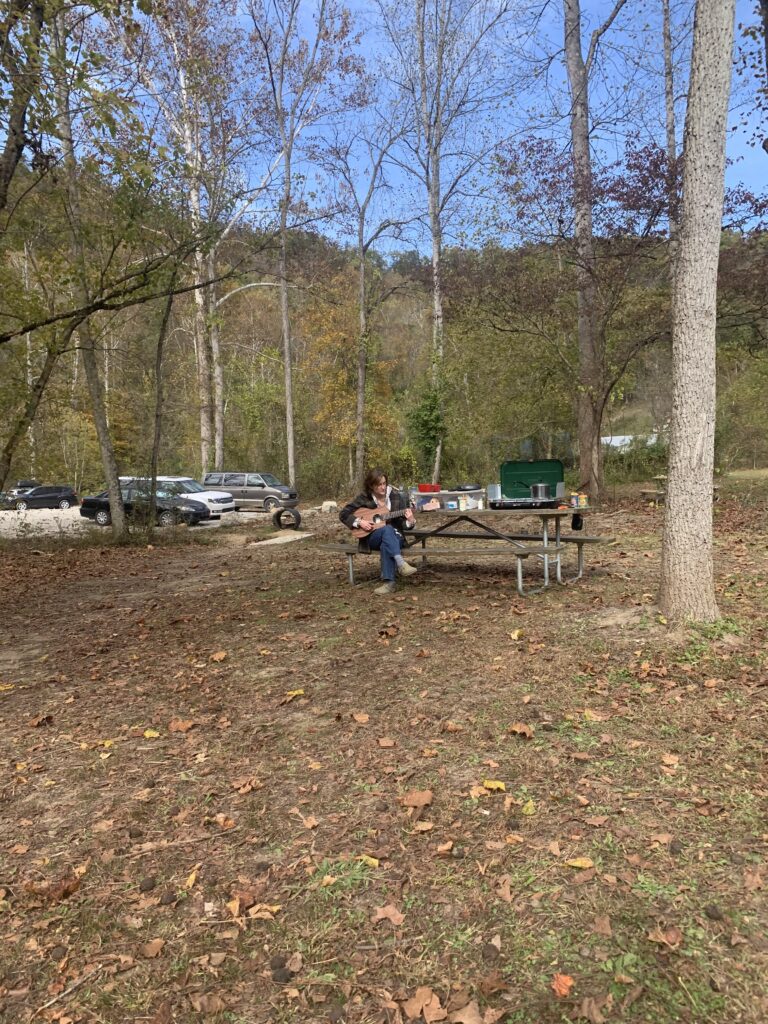
Me strumming at Miguel’s on a brisk autumn day while the soup heats up
Pick out songs that you’re excited to learn. Call up some friends and ask if you can play for them. Find a nice spot outside if the weather’s favorable. Give yourself joyful reasons to play your instrument, even if they seem silly.
Find the right instrument.
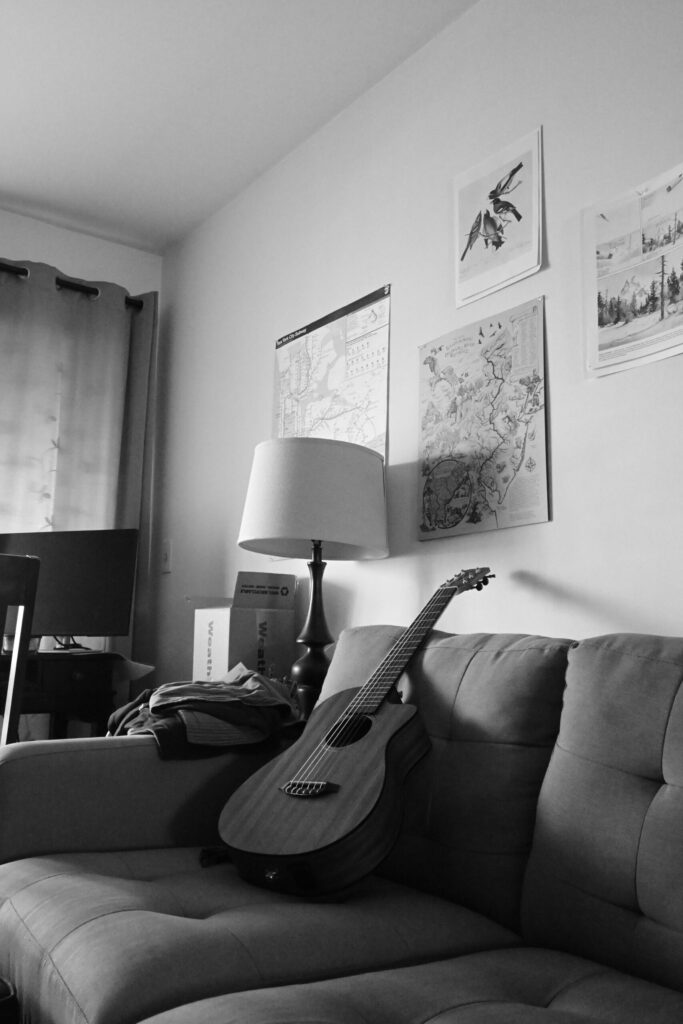
I haven’t grown since I was ten. When I was choosing a guitar to purchase, I asked myself, now, would I expect a ten-year-old child to play a full size guitar? My answer was no, certainly not. It doesn’t matter what anyone thinks of the little 3/4 size guitar that I ended up with. What matters is that it’s accessible to me, that I can make music without unnecessary struggle, and that I can share that music with others.
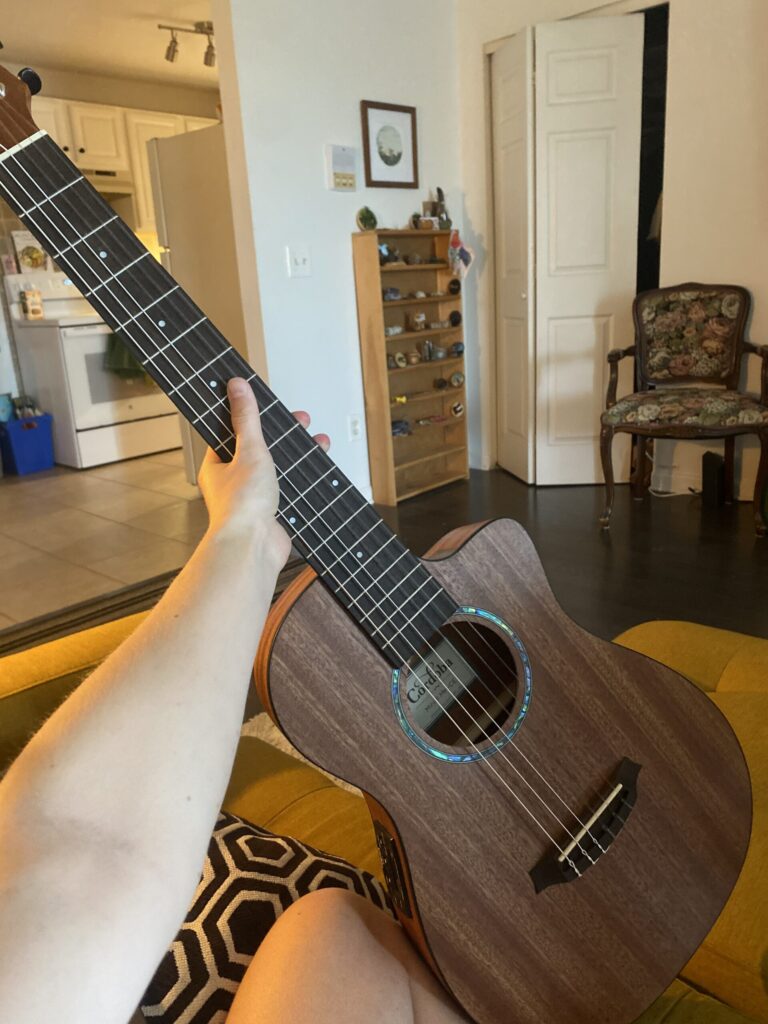
The first day with my tiny guitar
However serious or purely aesthetic your preferences are, get the instrument you want (within reason). If you like the bright purple ukulele, choose that one. If you’re a lefty, try to find a left-handed banjo. If you want to learn piano but can’t afford one and don’t have the space, get a melodica instead. There is an instrument out there for everyone, just waiting to be discovered.
Remember–the most important thing is just to play. If you’re more likely to play that purple ukulele all the time because it’s cute and it makes you laugh, get the purple ukulele. It will quite literally make you a better musician.
Learn how to read music in a way that works for you.
There are lots of different ways to write music down, and equally many ways to read music. In many cases, you don’t have to learn how to read traditionally notated music in order to make beautiful art. For folk instruments like the guitar, there are lots of other options, like tablature and chord charts. You also can practice learning by ear, if that suits you. If you’re more of a visual learner, you can watch YouTube videos about how to play your favorite songs (the artist will explain and demonstrate where to put your fingers).
Learning how to read off of a staff can be helpful, so I’ll leave a link here to an excellent educational website that will teach you how to read music if you would like to learn (and it’s free!). This site provides lots of high quality info, starting at super-introductory stuff and progressing all the way to advanced music theory.
Do your research on technique.
Instruments are designed by humans, to be played by humans. If something you’re trying to do or learn feels uncomfortable, there’s a chance you aren’t doing or learning it quite right. Studying technique can be one of the more dry aspects of learning an instrument, but in the long run, it makes your experience much more pleasant. Most of the time, the easiest and most efficient way to produce a sound will turn out to be the “correct” way to do it.
I had this experience while learning to play barre chords on the guitar. I started out by using a lot of muscular force, pressing as hard as I could to make the notes ring. With some YouTube research, though, I learned that having the right leverage allows you to apply much lighter pressure and still get the same sound (if not a better one!).
Set reasonable expectations…
There’s no need to immediately be riffing on the hardest songs you know. When I’m learning new songs, I always like to have at least one in rotation that’s in my “comfort zone.” For me and my guitar, that “comfort zone” means no barre chords, not all too many chords to remember, and a mid-range vocal span.
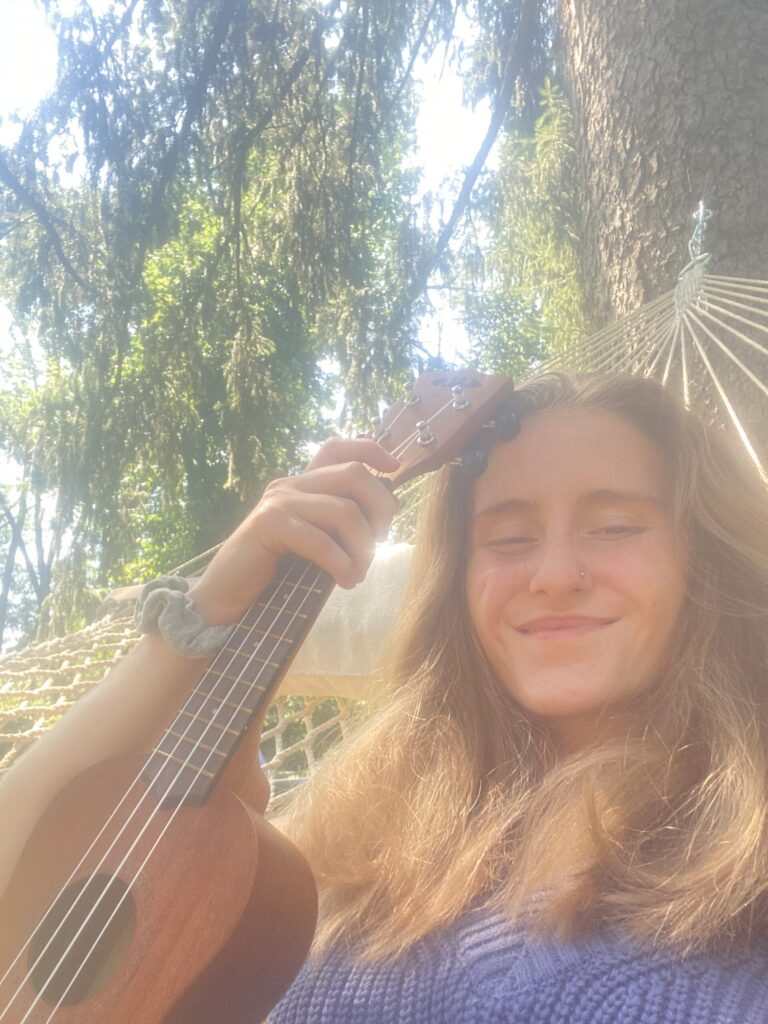
Me indulging in some comfort zone hammock time
If you’re totally brand-new to the music world, this “comfort zone” might not yet look like playing songs at all–and that’s completely fine. On guitar, it might instead look like switching back and forth between two chords that you know and striving for a smooth transition. You also could, on one continuous chord, practice a strumming pattern that feels comfortable for you.
Playing less complex music allows you to focus on some of the things that really matter: tone (sounding nice), expression (how well you can convey emotions), and genuinely enjoying your instrument. I encourage you to slow down and spend some time aiming for these more subjective qualities, even if you feel like you could play more challenging music by setting them aside for later.
…but also try hard things (with patience).
Some songs or skills are more intimidating than others. That doesn’t mean, though, that you should avoid learning them.
My experience in the classical world taught me that persistence and good practice matter more than almost anything else. If you can’t play a melody at full tempo right away…fortunately for you, it means almost nothing. Google “metronome,” set the click to a super slow tempo, and figure your riff out beat by beat. Once you can play the tune slowly, increase the tempo by (seriously) no more than 5bpm, maybe even less, and try it just that smidge faster. Rinse and repeat until you’re (literally) up to speed.
You can use this practice strategy to learn just about anything.
Use your resources.
Exercise your right to free education. Lots of people in the world play music, and you can find mentorship everywhere. Ask around your local climbing gym. Look up how to play a song you like on YouTube. Find the weird uncle at your next family gathering who used to jam out and ask lots of questions. More often than not, we as little humans are genuinely excited and willing to share our knowledge with others.
A crucial part of this process is humility. It’s hard to be a beginner in front of a friend or someone you look up to. Hiding away your blossoming skills until you’re fully satisfied with them, though, sorely limits your access to learning opportunities.
Listen a lot, and listen actively.
Practice is not just about making music–it’s also about listening. When you find yourself doing a fairly mindless or monotonous activity, like vacuuming or driving, put on some tunes that have your instrument in them and listen as actively as you can. If you’re learning guitar, notice what the guitarist is doing. Notice what you like about the way they play, and what you could do without. Listen to the genres that inspire you.
You also can find inspiration in unlikely places. Consume an ample serving of the genres and musicians that you want to sound like, but also occasionally put on a song that might surprise you. Art is all about borrowing. Even a folk guitarist whose favorite stage is the campfire can borrow ideas from funk or techno.
Do things that scare you.
Playing music for and with other people is one of the most wonderful parts of being a musician, but it can also be the scariest. I encourage you to be brave.
I was fortunate to have a small, casual venue to perform at regularly when I was first learning to songwrite. A whole range of musicians would perform at these events, each playing two or three songs. I wasn’t very good, but it didn’t matter. Having an upcoming mini-performance inspired me to practice, and actually being in the space inspired me to get more comfortable making music in front of others.
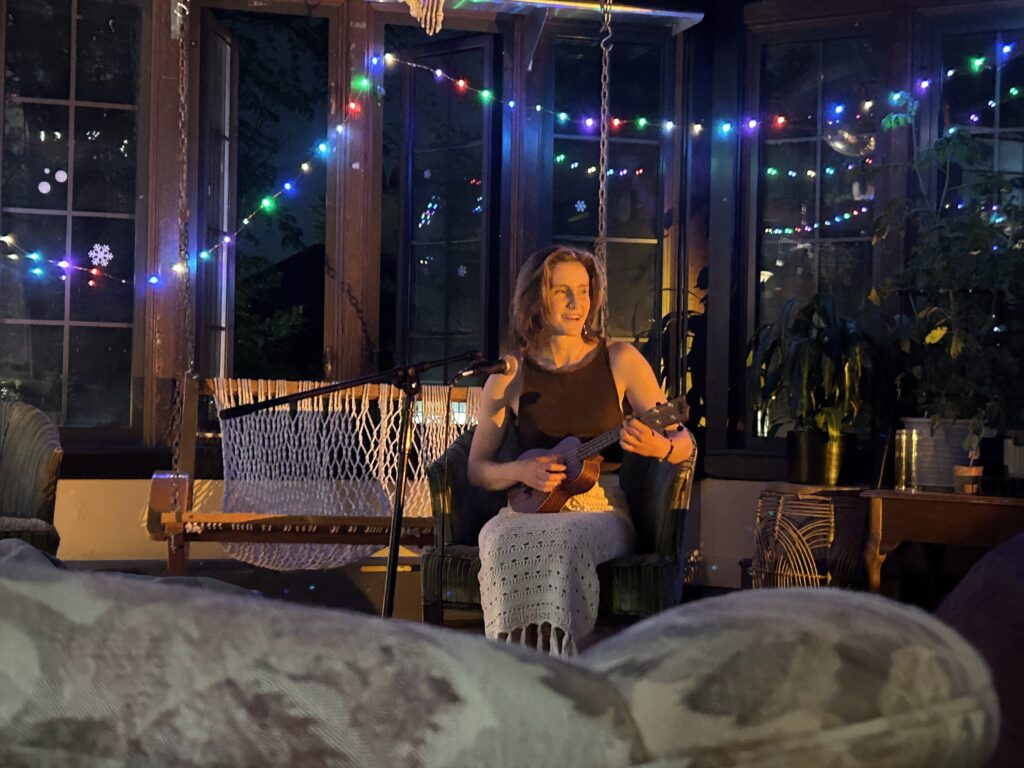
Me performing at a series called “Solarium Sessions” when I was still fairly new to ukulele (I knew like four songs)
It is totally, absolutely, way-more-than-okay to be bad at something. That’s how you start. A lot of people I know who are very fine musicians have still never written a song or had a casual jam session with friends. If you don’t know how to write music, the only way to start learning is to try writing a song. Your song doesn’t have to be catchy or clever–it just has to exist. If you don’t know how to improvise or jam, it might take playing some really wrong notes in front of people you respect before you’re on your way.
And it’s all okay.
Have fun.
I know that this is the last step of so many step-by-steps, but it’s truly crucial when learning music. When I was making lots of music with orchestras, one of the highest compliments the ensemble could receive was that our director or the audience could tell we were having fun. Trust me: it matters.
Art is all about the human condition, whether you’ve been making art for thirty days or thirty years. Enjoy yourself. There’s no other reason to do it.
Leave a Reply