
Endurance, or the ability to climb for long periods of time without tiring out, is a key skill for all climbers–even if you generally stay away from taller routes. Retaining your strength and technique until the end of a long session will help you with any kind of climbing, regardless of whether you favor bouldering, sport, or trad.
The good news is, endurance training doesn’t have to be boring. As a rock climbing coach and a dedicated climber myself, I’ve had plenty of time to collect all of the very best endurance workouts. Here are ten of my favorites that are guaranteed to get you sweaty.
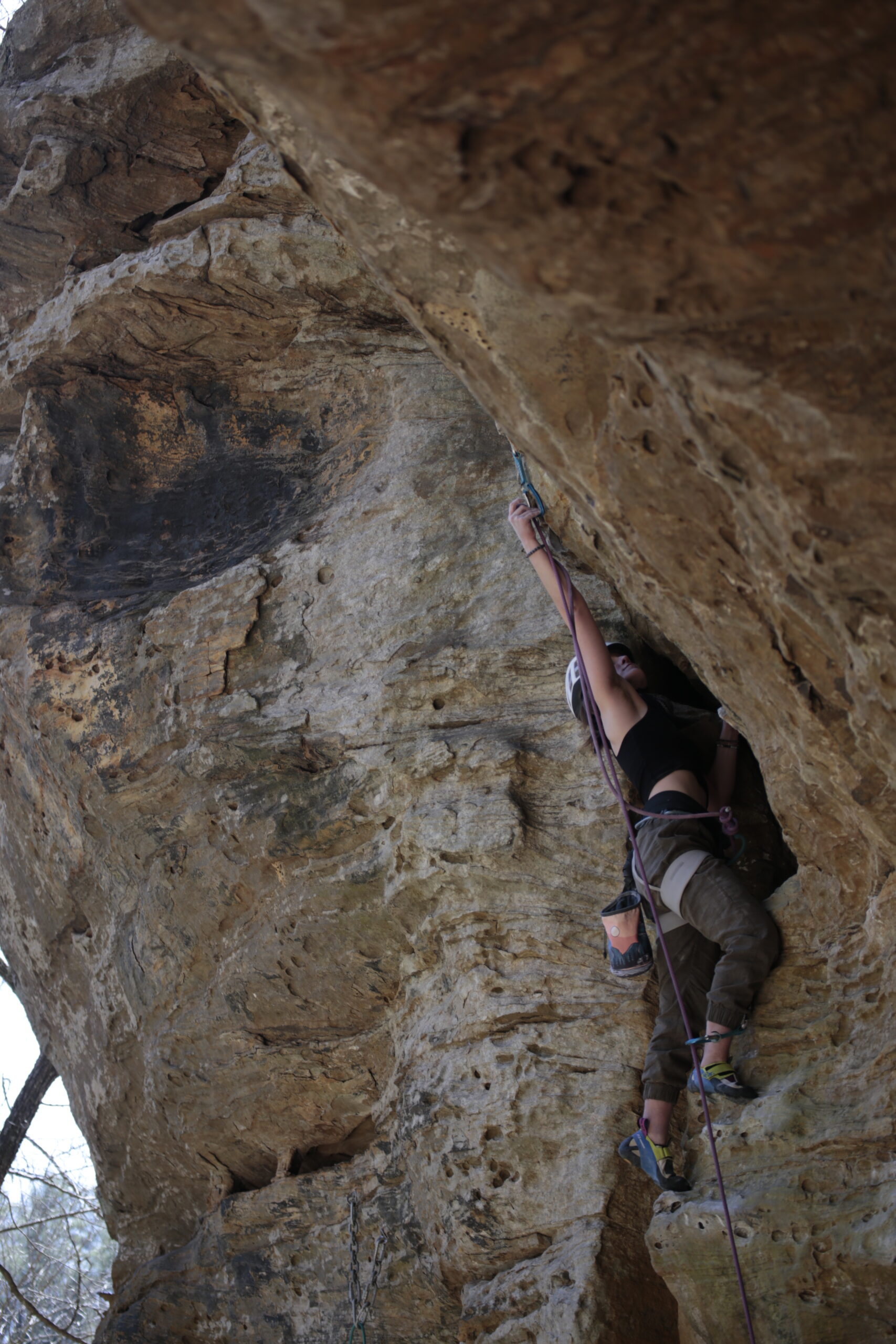
**Photo cover credit to our dear friend Max Curie–climber is me on Holy Grail at Camelot
Roped 4×4 Workouts
4×4’s are one of the most common endurance workouts. The rules are simple: choose four different routes, and climb each one four times in a row. When choosing climbs for this workout, look for the easier climbs in your onsight grade or climbs in grade just below your onsight. The goal is to spend as much time as possible on the wall, so select climbs that you almost certainly won’t fall on.
Listed below are all of the best 4×4 workouts you can do with ropes.
The Classic (with a belayer)
Follow the instructions above, trading with a partner after each set. This gives you ample time to rest before you’re up again. You also can do 4×4’s on an auto belay, but I don’t recommend it–it’s all too easy to accidentally cut your rest too short.
Quiet Feet (or other technique drill)
4x4s are the perfect workout for sharpening your technique, especially by including footwork drills. Repeating climbs allows time for the beta to sink in. As a climb’s beta becomes increasingly second-nature to you, you’ll have more and more space in your brain and body to focus on technique.
My favorite technique exercise to practice with 4×4’s is quiet feet: placing your feet as gently as you can with each move. It’s almost impossible to climb with bad technique when placing your feet quietly…and even harder to climb with good technique when placing them loudly. The repetitive and non-time-constrained nature of 4×4’s makes them a great opportunity to practice this kind of careful footwork.
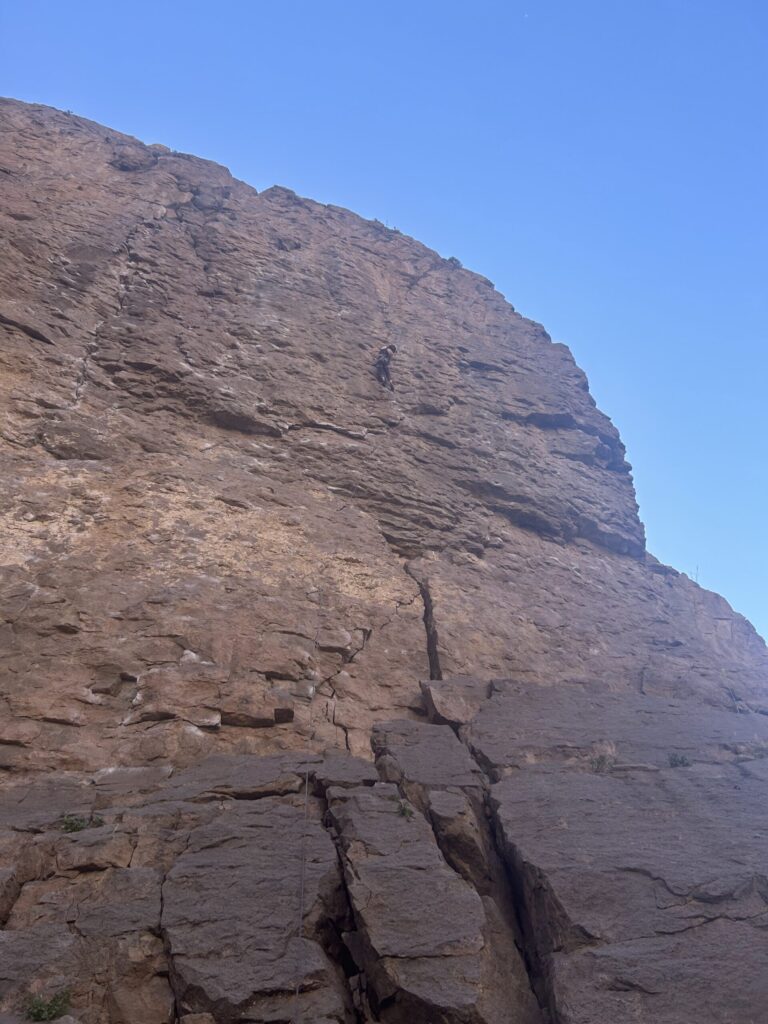
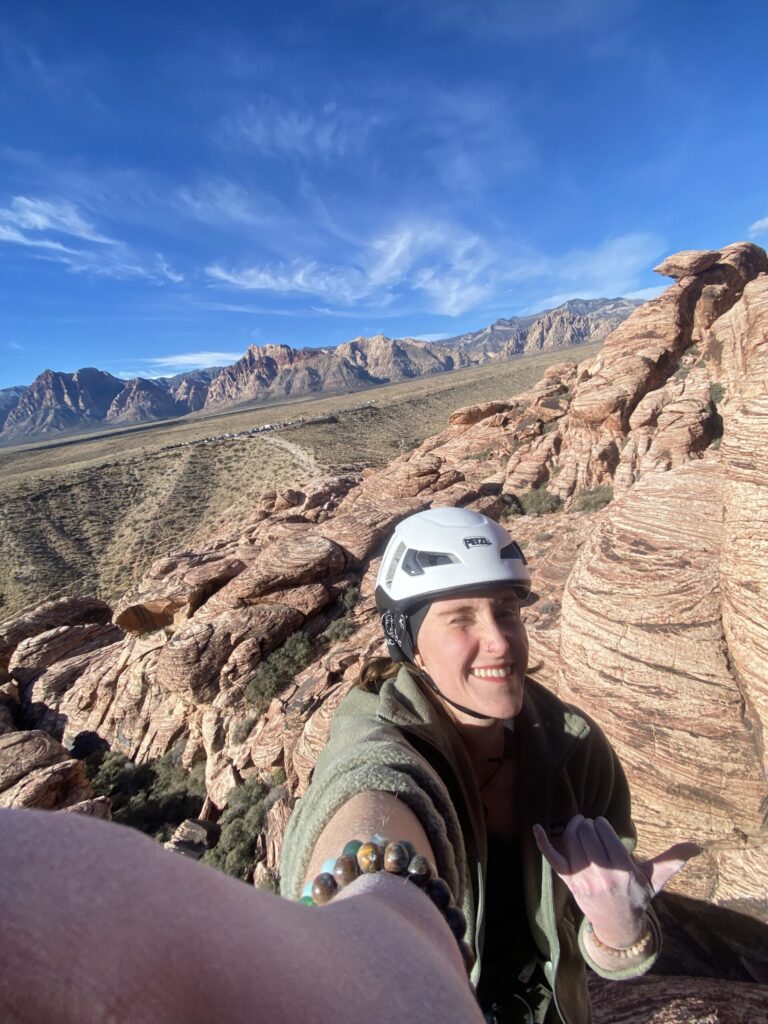
Arguably, you can only get this high up if you do your endurance workouts regularly
Lead 4×4’s (with downclimb)
If you want to train endurance on lead, one of the biggest roadblocks is that you usually must untie, pull the rope, and re-tie your knot every time your feet hit the ground. So what’s the workaround to climb more continuous lead pitches?
Skip clipping the anchors, downclimb each rep, and unclip as you descend. Once you get to the ground, you’ll have a perfectly-flaked rope waiting for you to complete your next rep.
This exercise can be a bit scary, but mental endurance is just as important as physical endurance. This one is a great exercise for getting your mind in shape for sport climbing season.
Bouldering Workouts
Your individual reps don’t have to be all too long if you’re doing lots of them. As long as you’re willing to run from one boulder problem to the next, you can keep your pump intact with these awesome workouts.

Considering the spray wall
A-Boulder-a-Minute
As a not-so-avid boulderer myself, I found out about this one from my co-coach (who loves to boulder). A-boulder-a-minute is exactly what it sounds like: set a repeating one-minute timer, and send one boulder every single minute. Most people do this for thirty minutes for a total of thirty boulders, but beginners can always start at 15 minutes or less. You then can crank up the time as high as you want as your endurance capacity increases.
There’s no need to only climb your onsight and above for this workout, but try to pepper in a few routes that are difficult for you. For example, if you’re a V5 climber, be sure to include a few V3’s and V4’s in your workout. If you’re a V2 climber, strive to complete at least one V1.
Climb the Gym
For this workout, select one or two (or even three) grades that are below your onsight and climb every single route in the grades at your gym. Begin with the easiest grade in the range you’ve selected. Once (and only once) you’ve completed every climb within that grade, move onto the next one. Repeat until you’ve exhausted your options and your forearms.
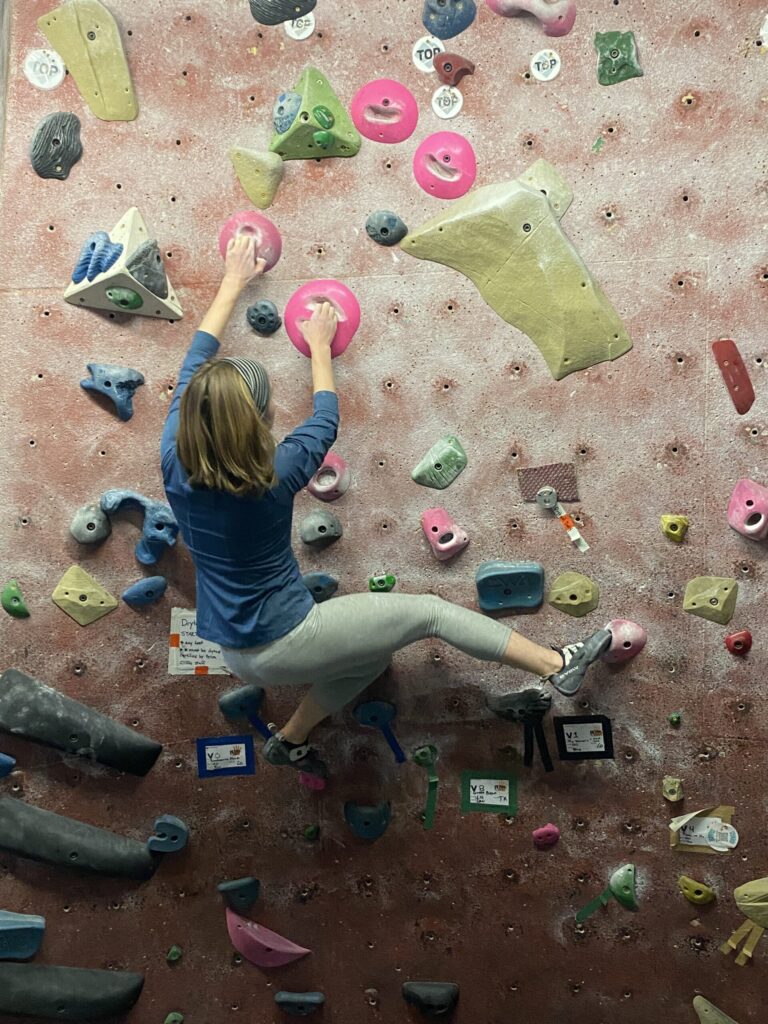
Rare instance of the author bouldering
“Climb the gym” works best in grade-balanced boulder caves, and can be less effective if your gym’s boulder assortment is skewed towards harder climbs. If you’re worried about this, take a quick stroll before you start the workout to make sure there are enough climbs available at your target grades. This usually means about ten climbs in each grade, but you can make do with at least five.
Campus Route Repeats
This is a tough one because you have to be comfortable with campusing first (climbing without your feet, like monkeybars). However, campusing is a skill that anyone can learn with practice, and I encourage you to give it a go!
It’s best to pick fairly overhung routes for this exercise so that your feet have room to swing, especially if you’re new to campusing. I like to do 3×3’s for this workout, campusing three different routes three times each. This one is a burner for your upper body. The trade-off is thus: less technique practice in exchange for more big-muscle engagement (like your lats). Campusing will improve your power endurance, allowing you to link longer sequences of burly moves without tiring. If that’s just what you need right now, then campus repeats is the workout for you.
If you’re having a hard time building the upper-body strength to access this workout, check out one of our older articles on getting your first several pull-ups.
Miscellaneous Roped Workouts
Hard Doubles
In my opinion, this is mentally and physically the most difficult workout on the list.
It’s also my favorite one.
For this workout, choose climbs that you won’t fall on…but only if you’re really trying. This often looks like a difficult project that you’ve recently sent and therefore know by heart, a super burly overhung climb that’s technically in your onsight grade but bucks you off if you’re tired, and other climbs of similar caliber. Choose between four and eight of this sort of climb, then ascend each one twice in a row with no rest in between reps.
The most immediate application of this workout is long outdoor projects. If you can climb your indoor project grade twice in a row, multiple times in a day, then your outdoor projects get just that much more accessible.
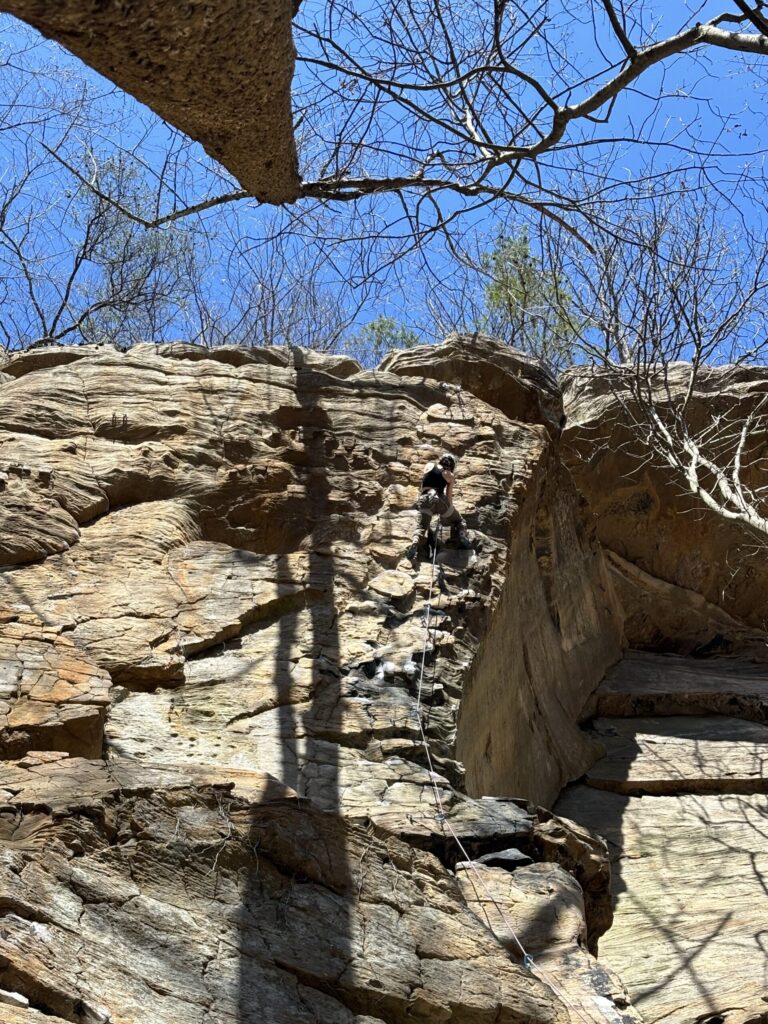
This workout is how you get strong enough to climb super long mega pump-fests like Brief History of Climb
10-in-10’s
You need a devoted and speedy belayer for 10-in-10’s. Once you have one such belayer, have them start a 10-minute timer the moment you leave the ground. Your belayer’s goal is to keep up with you and to lower you as quickly as possible between reps. Your goal is to complete the climb you’ve chosen ten times within the allotted ten minutes. I usually select climbs that are one full number grade below my onsight for this exercise, but I wouldn’t go any lower than that.
Complete at least two sets in a session. This exercise is tricky, and the time constraint demands quick, precise work in addition to forearm endurance.
Hang Time
Choose eight to ten climbs that are fairly easy for you. On each ascent, cut both feet and dangle for at least five seconds every time you move one hand. This exercise gets tough quickly, so there’s no need to climb anything particularly difficult. If you’re feeling confident, though, you can always hang for longer, repeat climbs (like in 4x4s or hard doubles), or add more routes to the docket. This exercise is pretty slow-moving and requires some patience, but don’t forget to have fun with it! Kick your feet, do pull-ups, or whatever else your heart desires while you’re hanging.
In the Fitness Room
Hang Until Failure
This one’s simple: find a bar, and dangle until you can’t anymore. I usually complete at least two sets of this.
If you want to work on hanging for longer, there are a few tips I have for you.
The first tip is to set a time goal for yourself and place a stopwatch (on your phone or otherwise) somewhere that you can see it. If I know that I’m almost at the two-minute mark, I’m much less likely to let go of the bar than if I have no idea how long I’ve been up there.
The second tip is to train these hangs with resistance bands. If you aren’t hitting your goal while free-hanging, try instead to hit that goal with the help of a heavy band. Once you can do that, trade out the resistance band you used for a lighter band. Use increasingly lighter and lighter bands until you can hit your goal without any assistance at all.
Conclusions
Endurance days round out your training schedule and, most importantly, help you climb longer. This kind of training keeps you on the wall, helps you manage your energy levels, and can even improve the quality of your projecting and strength training sessions.
As a free resource crafted for climbers like you, our goal in the Gorge is to provide you with as much information as possible. I hope that this bounty of workouts will help you diversify your endurance days and overall make your training more effective!
Leave a Reply